
Olympic dreams

It’s about the Northwest and its mountains, salt water, clouds and forests.
And it’s about art – art that is alive, that seemingly changes with every snowflake, sunbeam and soft breeze.
After nearly a decade’s wait, the Seattle Art Museum’s Olympic Sculpture Park is slated to open to the public Saturday, with a packed schedule of family activities, tours, art-making opportunities and dozens of music and dance performances.
The $85 million, nine-acre park – a former contaminated industrial site – zigzags from the upscale Belltown neighborhood to a driftwood-covered beach along Puget Sound.
Its architectural design and landscaping make it almost impossible to tell that portions of the park are suspended over the bustling Elliott Avenue and a set of heavily used Burlington Northern railroad tracks.
“We aspired to create a sculpture park at the intersection of the city and the water, and to define a new model for bringing art to the public,” said Marion Weiss of Weiss/Manfredi Architects, a New York-based firm that designed the park.
The project, funded through a massive capital campaign, features more than 20 pieces, including works from the museum’s collection, sculptures commissioned for the park, loaned pieces and changing installations.
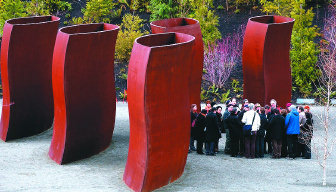
Prominent pieces include the nearly 40-foot red “Eagle” by Alexander Calder, and the titan-size “Wake,” a series of five monumental pairs of curved steel forms by Richard Serra.
Each of the 10 plates used to build “Wake” weighs nearly 30,000 pounds. The rust-colored panels were fabricated in Germany, and eventually they’ll turn dark amber in color, said Serra, who has created large public art pieces in New York, San Francisco and elsewhere.
Traditionally, art has only been accessible to a particular class, but efforts such as the Olympic Sculpture Park help make art more available to the community, he says.
“I think the opening of this park is a historic moment,” Serra said during a tour of the park last week. “There’s nothing else like this in the United States.”
From native plantings in its gardens to salmon restoration efforts along the beach, the environment played a huge role in the development of the park, museum officials say.
From 1900 to 1975, the site was a fuel transfer and distribution center for Union Oil Co. of California. It took almost a decade for the company to remove nearly 120,000 tons of petroleum-contaminated soil from the property and treat millions of gallons of groundwater under an agreement with the state Department of Ecology.
The museum paired up with the conservation group Trust for Public Land to acquire the property, which a developer had hoped to turn into condominiums, office space and a hotel.
“When we first saw these two brown lots, we had to have a lot of faith to buy them,” said Jon Shirley, chairman of the museum’s board of trustees.
Designers incorporated native plantings such as fir, cedar, hemlock and coastal flowering shrubs and trees throughout the park. A newly created grove of aspen will someday tower amid the artwork. And park officials hope juvenile chinook salmon, migrating from the Duwamish River to the Puget Sound, will find some much-needed protection along the park’s newly repaired seawall and restored shoreline.
Environmental messages also are evident in several pieces of the artwork.
“Neukom Vivarium” is a combination of sculpture, architecture, horticulture and environmental education. Artist Mark Dion created the piece, which includes a greenhouse that houses a 60-foot-long “nurse log.”
The moss-covered log is from a 150-year-old tree that fell during a 1997 windstorm in the Green River watershed. Visitors can use microscopes and magnifying glasses to watch the log’s ongoing decay and support of other life such as ferns, moss and bugs.
“One of the ingredients of this piece is time,” Dion said.
Museum officials have joined with several groups, including the Audubon Society and Woodland Park Zoo, to organize a variety of environmental education programs at the park.
Named after the snow-capped peaks that seem within reach of the park, at least on a clear day, the Olympic Sculpture Park offers views of the Space Needle, several Seattle skyscrapers, the Port of Seattle’s shipyards and Mount Rainier.
It’s Seattle Art Museum’s third site, joining Volunteer Park’s Seattle Asian Art Museum and the downtown Seattle Art Museum, which is undergoing a major expansion as well, scheduled to be completed in May.
The park also is Seattle’s last and largest waterfront property.
Seattle Art Museum director Mimi Gates describes the sculpture park as “transformative.” Not only has it turned a former industrial site into green space, she said, it’s also creating a cultural legacy for the region.
“Generations are going to grow up living with this art,” Gates said.