
Thirst for Orthodoxy
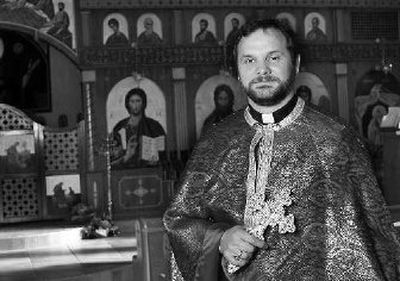
Greg Mencotti worried he would never find a spiritual home.
The Sunday school teacher grew up Roman Catholic, lost his faith and became an atheist. Eventually he returned to Christianity, this time as a born-again Christian, spending years worshipping in a Methodist congregation.
Still, he felt his search wasn’t over.
That led him to the Holy Spirit Antiochian Orthodox Church in Huntington, W.Va., a denomination with Mideast roots that, like all Orthodox groups, traces its origins to the earliest days of Christianity.
Today, Mencotti is one of about 250 million Orthodox believers worldwide and among a significant number of newcomers attracted to this ancient way of worship. The trend is especially notable since so few in the United States know about the Orthodox churches here.
“I was like most Americans,” said Mencotti, who was urged by his wife to explore Orthodox worship. “I didn’t understand anything about Orthodoxy.”
Orthodoxy was born from the Great Schism of 1054, when feuds over papal authority and differences in the liturgy split Christianity into Roman Catholic and Eastern Orthodox halves.
Orthodox churches say they have continued the traditions of the original Christian faith, dating back to the days of the apostles.
In the United States, Orthodox Christians are a fraction of religious believers, numbering about 1.2 million, according to estimates by Orthodox researchers.
In the past, their growth had been fueled largely by immigration, with churches forming mainly along ethnic lines. Some converts came to Orthodoxy through marriage to a church member.
That trend has broadened. There are no exact figures on the rate of conversion across the 22 separate U.S. Orthodox jurisdictions, but the numbers are steadily rising.
Locally, growth at St. John the Baptist Orthodox Church in Post Falls led to the founding two years ago of a new, spinoff parish in the Spokane Valley, Christ the Savior Orthodox Christian Church. More parishes are planned in Spokane as the congregation grows, says William Persons, treasurer of Christ the Savior’s parish council.
The oldest Orthodox church in the area, Holy Trinity Greek Orthodox Church, has gained visibility by holding a Greek Festival for the past 71 years.
“Every year we get a steady trickle of those who come and don’t leave,” says church member Nancy Despopoulos, herself a convert to the Orthodox faith.
When Mencotti began attending Orthodox worship in West Virginia, the church was packed with converts, including its pastor, the Rev. John Dixon.
About one-third of all U.S. Orthodox priests are converts, and that number is likely to grow, according to Alexei D. Krindatch, research director at the Patriarch Athenagoras Orthodox Institute in Berkeley, Calif.
A 2006 survey of the four Orthodox seminaries in the country found that about 43 percent of seminarians are converts, Krindatch said.
Many converts credit the beauty of the liturgy and the durability of the theology, which can be a comfort to those seeking shelter from divisive battles over biblical interpretation in other Christian traditions.
Dixon, who was raised an Old Regular Baptist, an austere faith of the Southern Appalachians, said his conversion grew from his studies about the origins of Christianity as an undergraduate at Marshall University. The turning point came when he first attended services at an Orthodox church.
“As soon as I came in that day,” he says, “I knew I was home.”
Convert-fueled growth, though, has its challenges.
Like converts in all faiths, the newly Orthodox bring a zeal that can be unsettling for those born into the church, who tend to be more easygoing in their religious observance. Parishes run the risk of dividing between new and lifelong parishioners, Krindatch says.
“Converts to Orthodoxy form their own little quasi-seminary and it’s almost a closed group,” says the Rev. Joseph Huneycutt, associate pastor of St. George Antiochian Orthodox Church in Houston, who was raised Southern Baptist, then became Orthodox.
Huneycutt is the author of “One Flew Over the Onion Dome,” a book about conversion scheduled for release in March by Regina Orthodox Press, and the editor of OrthoDixie, a blog about Orthodoxy in the South.
He says he was drawn to the faith by the beauty of its rituals and its teachings.
On his first visit, he says, the church was filled with the smell of incense and the sound of the chanted Divine Liturgy. The altar was largely concealed by the iconostasis, a large screen or wall hung with icons of Christ, Mary, angels and Apostles.
And worshippers received Communion from a chalice and spoon.
“I had become convinced that the Eucharist was the center of Christian worship – ancient Christian worship,” Huneycutt says. “Once I had reached that point in my personal walk with Christ, there was no going back.”