
Winter storm watch
It’s not very often that a successful getaway requires bad weather, but winter storms are a main draw for folks visiting the Oregon and Washington coasts this time of year.
Late winter and early spring weather patterns often promote strong winds, rain and large waves up and down the coast. The power and the fury of the waves can be dramatic, especially along a rugged coastline with rocks and cliffs for the waves to crash over and around. A visitor can experience the constant roar, the driving rain and occasionally, when a really big wave hits, the trembling of the ground as if a small earthquake has struck. It is nature showing one of its most powerful and relentless forces that helps build and carve the rugged and beautiful landscape of the Oregon and Washington coastline.
There is something very primal about the ocean that can draw you to it. Maybe it’s the salty air or the constant roar of the ocean pounding on the beach, or simply the scenic impact of it all.
Guy DiTorrice, a longtime resident of Lincoln City, Ore., helps explain why a winter visit is a great idea.
“Winter storms are a very normal part of the Oregon Coast – similar to leaves turning color in New Hampshire, snow falling in Colorado and sun shining in Florida. However, the media make the winters sound as if it rains every day and it’s always blowing sideways. This is simply not true. The conditions change hourly, showing clouds, sun, fog, clouds and more sun in a five-hour period.
“DiTorrice says that he walks on the beach two to three days a week – year-round. His dogs love the cooler misty days of winter as much as the many sunny days throughout the year. He is amazed at how many winter sunsets he gets to watch on the beaches during the months when no one else is around.
“Agate-, rock- and fossil-collecting is best in the late winter and early spring in Oregon. The winter storms and currents move the sand off the beaches, exposing gravel bars, ancient tree stumps and a wide assortment of items buried during the summer (sandy beach) months.
“The Oregon Coast is host to hundreds of lodging choices, many with ocean views, where one can stay safe, warm and dry while enjoying any level of storm. The rates are lowest during the winter.
“The Oregon Coast has one of the longest stretches of public beach in the world.
“There are hundreds of indoor attractions for a full range of personal activities – from art galleries and craft shops, museums and aquariums and gaming casinos to historic buildings to health clubs.
You might think this guy sounds like a chamber of commerce type. He used to be, but it’s obvious that he loves the coast.
Another coastal resident, who lives in Astoria, Ore., Roger Rocka, says Fort Stevens State Park near Astoria is a great place for storm-watching. You can sit in the comfort of your car on a bluff overlooking the beach and watch the waves crashing around the remains of the British sailing ship Peter Iredale, which went down in 1906. Or, if you are especially adventurous, you can go across the Columbia River to Cape Disappointment Lighthouse and experience winter storm winds that reach 90 to 100 mph.
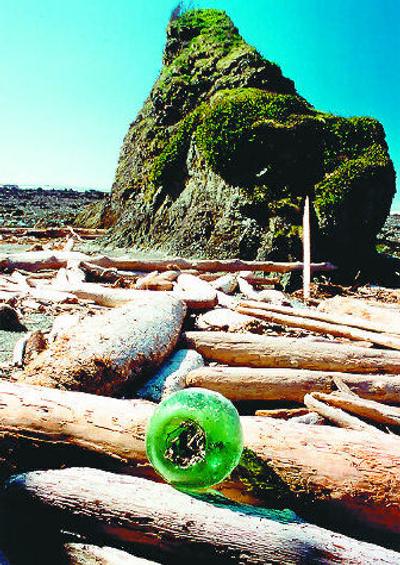
For many along the coastal beaches, especially after a winter storm, the ultimate prizes worth searching for are hand-blown Japanese glass floats. Mostly round, green or clear and of various sizes, the glass balls travel all the way across the Pacific Ocean and somehow survive the rocks and sea stacks to land on the beaches. There are photos in some of the gift shops of bygone days when beachcombers would find so many of the floats they would stack them in large piles on the beach. The floats still arrive, but rarely, making them a treasure to find. The floats range in size from baseball to volleyball to basketball size. The largest were used on large nets used in tuna fishing. The small ones are used in gill-net fishing, and the sizes in between are for bottom-fishing. Many of the Japanese glass floats were made out of surplus material, so they are the color of the glass that was at hand.
Today Japanese fishermen are using different methods of fishing, including plastic floats. Finding a plastic float just isn’t the same as finding one of the beautiful, hand-blown glass floats.
In memory of those floats, Lincoln City this year is placing glass floats on the beach; some will be washed out to sea during storms. Since October, about 65 floats – each numbered by the artist – have been placed each week along the 7 1/2 miles of the Lincoln City public beach.
Glass floats are just one of the reasons to make a trip over to the coast to take in a winter storm watch. A natural event that will allow a visitor to witness the ocean with all its fury – powerful and large waves, driving winds and rain. So, hope for some really bad weather – at least on the coast.