
Stepping into silence
There’s no off-season for the hikers in the North-Idaho based Friends of Scotchman Peaks Wilderness.
The group that scheduled a series of guided summer hikes to acquaint people with proposed wilderness areas north and northeast of Lake Pend Oreille has announced an ambitious series of winter hikes for snowshoers.
“Winter is a time of profound peace and solitude, a time to experience the silent side of the Scotchmans,” said Phil Hough, of Sagle, chairman of the group advocating wilderness status for 88,000 acres in the Cabinet Mountains of Idaho and Montana.
But he made that statement before a group of Spokane Mountaineers drove into Western Montana, headed north on Highway 56 to just south of Bull Lake, buckled on their snowshoes and started trudging up the 3 miles of snowed-in Kootenai National Forest road leading to the Ross Creek Cedars.
Instead of the anticipated quiet stroll through calf deep powder, the snowshoes scratched and grated over an icy crust that wasn’t going to change in the single-digit temperatures.
Hough smiled, shrugged his shoulders and led the long line of noisy web-footers toward one of the region’s few remaining natural cathedrals of ancient old-growth.
At other times of year, visitors can drive to the site and hike a trail that weaves nearly a mile through the 100-acre grove dominated by Western red cedars that had sprouted before Columbus landed in America.
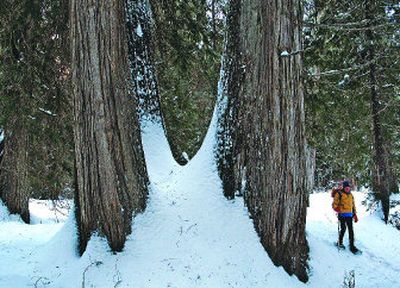
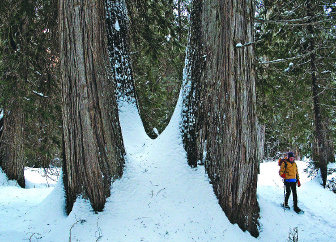
Winter visitors work harder to get there, and they see a totally different picture. Instead of an under story of lush greenery, the floor of the grove is wide open and mostly white with Mother Nature’s ice sculptures created along the creek.
Huge cedars, 8 feet in diameter and up to 175 feet tall seem to have sprouted from marshmallow topping.
Prickly skeletons of devil’s club poke above the snow in some areas, but the ferns are biding their time under five feet of snow.
The snowshoers carefully crossed Ross Creek over several foot bridges in which the snow had piled up as high as the hand rails. They passed a tree with a shelf chopped into its side, a reminder that trappers once pursued pine martens in this area. They paused to investigate the lonesome track of a fisher, a larger member of the weasel family.
At one point, Hough asked everybody to stop and simply stand still to calm the clatter.
“Take 30 seconds and just listen to the quiet,” he said.
And they did, just in time to hear the faint rap of a woodpecker up the creek.
The cedar grove itself has reasonable protections after being designated a national forest scenic area in 1960. But the watershed above and ranging westward bordering the Clark Fork River and Lake Pend Oreille is not protected and could be developed, Hough said.
A person from Lincoln County, Mont., has become the 1,000 member of the Friends of Scotchman Peaks Wilderness, he said, noting that these places are important even to the people who never set foot in them.
“We get a lot of grassroots support, especially when we have a chance to show people what it is we want to protect,” he said, noting that officials from both the Panhandle and Kootenai national forest have indicated support for wilderness designation.
From this gentle walk in the cathedral-like Ross Creek Cedars to steep and strenuous ascents of Star and Scotchman peaks, the group’s snowshoeing treks offer a challenge for hardy visitors to see the issue first hand.
Even the Friends of the Scotchmans are thrilled by discovery on some of these outings. About two weeks ago, Jim Mellen, one of the trip leaders, discovered four sets of wolf tracks crossing the Ross Creek Cedars access road.