
FIRE & ICE
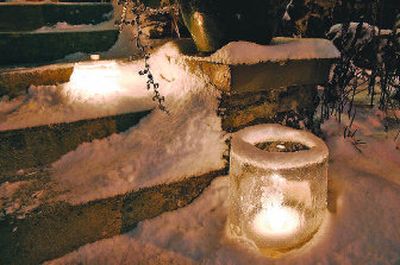
Few people look forward to subfreezing temperatures this time of year, but Rebecca Mack is one of them. While the rest of us are trying to escape the cold, Mack is using it to create elegant sculptures of fire and ice.
“I love how ephemeral they are,” she says of the half-dozen homemade ice candles illuminating her front steps. “You can really only capture the ice that way for just a few nights at this time of year.”
Mack, who is a Chicago native, says her mother taught her to make the frozen candles as a child growing up during frigid Midwest winters. Today, the mother of four continues the tradition at her South Hill home as a way to get through the winter doldrums.
“You have to find some way to be joyful when it’s miserable outside,” she says. “Making ice candles turns the bitter cold on its head.”
For Mack, ice candles are all about seizing the moment.
“You never know how long it’s going to last,” she says of the frosty conditions needed to freeze large buckets of water that form the glasslike casing of her luminescent lanterns.
Mack’s son, Harry Hagood, says the faster the water freezes, the clearer the ice. But his mother likes the way that bubbles and other imperfections formed at varying temperatures can refract the candle’s flame.
“My boys love it; they can get really creative,” she says, adding that another son, Benjamin Hagood, uses beet juice as an environmentally friendly way to color the ice. Other experiments involve different containers – even soup cans – though Mack says 5-gallon buckets work best.
“It’s simple, but like anything else there are fine points,” she says. For example, she says, hot water actually will freeze more quickly than cold.
This year she worries the area’s most recent arctic snap won’t last long enough to enjoy her evanescent creations.
“You have to have lasting cold, and we haven’t had a sustained, subfreezing cold,” she laments. But the candles will last for several days, even at above-freezing temperatures, once they are made. “They don’t disappear right away.”
And when they do?
“They leave no trace,” she says. “There’s no storage, no cleanup, no expense, just water and winter working together.”