
Helmet safety sparks debate

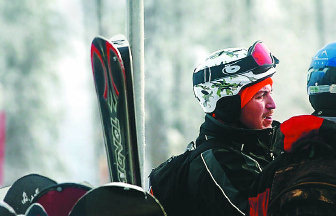
Steve Bradshaw, 49, of Portland, has skied for most of his life. But only three years ago he added a piece of basic equipment – a helmet.
“I wouldn’t even think about going up on the hill without mine,” he now says.
Helmet use, shedding its uncool image on U.S. ski slopes, is rapidly escalating; now an average of 40 percent of skiers and snowboarders use them.
Medical and safety experts generally agree that helmets can reduce some kinds of injuries, and the U.S. Consumer Products Safety Commission urged their use after a 1999 study found helmets saved lives. Still, there is debate over their use and overall effectiveness.
That debate flared after Geoffry Bradeen, 45, of Portland died of a head injury Jan. 5 while skiing at Oregon’s Mt. Hood Meadows. Investigators believe Bradeen fell and was hit from behind by a snowboarder as he was getting up.
A helmet would likely have saved Bradeen, who died of a skull fracture, said Dr. Karen Gunson, Oregon medical examiner.
But collisions between two people are rarely fatal, studies show. One-on-one collisions account for just 6.4 percent of reported ski accidents, said Jasper Shealy, who has studied skiing and snowboarding injuries and fatalities for 35 years.
Most skiing and snowboarding deaths are caused when a person hits a tree or other fixed object at high speed. In that scenario, the person almost always suffers fatal chest and torso injuries, Shealy said.
“Frankly, you’re going to need more than a helmet to prevent that fatality,” he said.
Shealy is chairman of the American Society for Testing and Materials International’s skiing committee and a U.S. technical delegate for the International Standards Organization relating to skiing. He and others looked at 562 deaths from fall 1991 through spring 2005, finding that 60 percent of deaths were the result of a skier or snowboarder hitting a tree.
Hitting the snow is the second-biggest killer, with 9.7 percent, and colliding with manmade objects, such as lift towers, is third, with 7.6 percent.
The researchers found that helmet use was growing by up to 5 percentage points a year, and that the number of deaths – an average of 38 a year – was steady.
A U.S. Consumer Products Safety Commission study concluded that 44 percent of 17,500 head injuries to skiers and snowboarders in 1997 could have been prevented or reduced in severity if helmets had been worn. It suggested that helmets could prevent an average of 11 deaths a year.
The agency also found that while the number of skiing-associated emergency room visits declined between 1993 and 1997, snowboarding injuries nearly tripled and the number of snowboarding head injuries increased fivefold.
However, the number of people snowboarding during that time increased just 30 percent, to 2.5 million, the National Sporting Goods Association said.
At Mt. Hood Meadows, the medical clinic sees two or three major head injuries a year, said Dr. Mike Murray, its director. Doctors at the Mountain Medical Clinic treat far more minor head injuries such as concussions and lacerations, he said.
And many people wearing helmets still get concussions, he said.
“There’s really no helmet currently on the market that is designed to decrease the rate of minor concussive injury,” he said.
Murray said ski helmets are designed to prevent major head injuries even though those are “less likely to happen anyway.”
Since Bradeen’s death, many Mt. Hood Meadows regulars have reiterated a longstanding complaint that snowboarders pose a greater risk to others, particularly on crowded weekends. Murray said snowboarders do more jumps and use the hill differently than skiers by weaving side to side. And because they are riding sideways on their boards, they have a blind spot when they turn toward their heels.
“The more snowboarders you see, the more head injuries you’re going to see,” Murray said. “Eighty to 90 percent of the head injuries we see are snowboarders.”
Mt. Hood Meadows is more aggressively revoking the passes of people who are skiing or riding dangerously, President Dave Riley said.
Regardless of what side of the debate you fall on, Murray said, wearing a helmet is generally a good idea. It certainly couldn’t hurt you.
Bradshaw agrees. The first day he wore his new helmet three years ago, he was hit by a snowboarder.
“I felt something hit my head. This guy was a cruise missile,” he said.
“It’s about the best insurance you can buy up there.”