
‘Tremble Clefs’

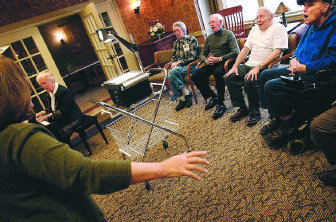
Ed Ewell is a bear of a man, with a booming bass voice to match.
Ewell also has Parkinson’s disease, a degenerative disorder that can weaken the voice as well as cause tremors, rigidity and a host of other neurological symptoms.
But last week, after an hour of singing with the Tremble Clefs – a choir for people with Parkinson’s – Ewell says his symptoms eased a bit.
“I came up purely to watch,” says Ewell, co-founder of Spokane’s Parkinson’s Resource Center. “By the second song, I was really enjoying myself. … I feel way better now than when I came here.”
The small group of singers, which meets every other Tuesday at Rockwood South Wellness Center, is finding healing through belting out songs like “Sentimental Journey,” “Zippity-Doo-Dah” and “Edelweiss.”
“It kind of rejuvenates you,” Ewell says between songs.
The Spokane chapter of the Tremble Clefs, part of a national organization of singing groups for Parkinson’s patients, started about a year and a half ago. It’s currently a small group, with about a half-dozen singers.
“That’s been our biggest challenge … getting people to us,” says Sara Nielsen, a speech therapist who organized the group. “A lot of the people who are good candidates for participating don’t drive, so our numbers are kind of small.”
Singing, Nielsen says, is a perfect form of therapy for people with Parkinson’s disease.
“Singing is just a really natural way to exercise the muscles for speech,” she says. “For speech to be loud enough and clear enough, they have to exaggerate. And singing is a really easy way to get people to exaggerate.”
And that’s just what Roy Hoffman, a 60-year-old Spokane resident, did with the choir last week, making big, careful movements with his mouth as he sang each word of “Do Re Mi” and “My Wild Irish Rose.”
Hoffman, who has had Parkinson’s for about a decade, uses a wheelchair to get around. He takes the bus to sing with the Tremble Clefs.
“It’s great. It’s just tremendous,” he says.
Nielsen leads the group through exercises to work their facial muscles. Then Ruth Palnick takes over.
Palnick, 53, was diagnosed with Parkinson’s about five years ago. Medication controls many of her symptoms, she says, but she can’t help noticing the disease’s subtle spread. Last month, she says, she realized her handwriting becoming small and cramped – a hallmark of the condition.
She continues working full- time, including as a chaplain for Hospice of Spokane, in addition to singing and public speaking.
She stands in front of the Tremble Clefs, her lilting soprano leading them through standard after standard.
“OK, now, big finish,” she says at the closing of “I’m Looking Over a Four-Leaf Clover.”
Besides being good exercise for the facial muscles, singing also stimulates the limbic system, the part of the brain that makes us feel good.
“It’s just a great boost for people,” Nielsen says.
The singers are accompanied by Margie May Ott, a legendary Spokane pianist who lives at Rockwood. Ott is 86 and has been teaching piano since she was 11 years old.
Participants are encouraged to sing a little each day to reap the full benefit of the therapy.
“It has to be something done on a regular basis,” Nielsen says. “Most of the time, we see some of the old habits of speaking quietly and not as clearly when they arrive. When they’re done singing, everyone is chatting and socializing.”
Chuck Steiner, a 73-year-old Spokane man, comes to sing with the group because he notices a big change in his speech after his session. When his kids call on the phone later, they can tell he’s been singing that day.
“I think it’s excellent,” says Steiner, who has had Parkinson’s for 11 years. “It brings out the singer in me I never knew I had.”
After a nearly hourlong vocal workout the group mills about, eating cookies and talking to each other.
The social aspect is a big part of the appeal, participants say.
Says Palnick, after the group wrapped up singing “Side By Side”:
“This is kind of our theme. We know by coming here, we support each other.”