
Notebook: Under watchful eyes
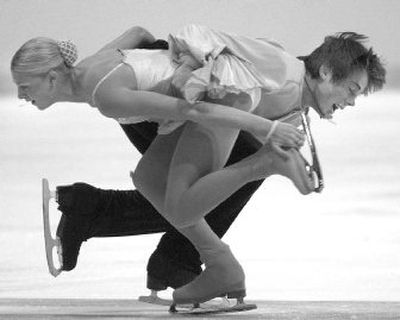

During a 35-minute practice session Tuesday at the Spokane Arena, Emily Hughes stopped skating 15 times to visit coach Bonni Retzkin. On perhaps 10 other occasions, Hughes did a quick skate-by, exchanging a few words or a hand signal with Retzkin without stopping.
“How many times did she come by?” Retzkin asked later. “Fifteen? Well, we’ve been together a long time. I’ve been teaching her since she was 4. She can skate around and look at me and know what I want her to do.”
Their interaction “depends on how she’s doing and the frame of mind she’s in, which is usually a good frame of mind,” Retzkin said. “I’d say she’s happy 98 percent of the time. Today? Great, no complaints.”
Hughes shared the ice with six others and seemed to have fewer skater-coach visits than her counterparts. At one point, only one competitor was actually skating as Hughes took a break for a drink of water while four others chatted with their coaches.
“It’s just affirmations,” said Themi Leftheris, who joined partner Naomi Nari Nam in dozens of chats with coach Peter Oppegard during Monday’s practice. “It’s, ‘You’re over your feet,’ or ‘This is where you belong,’ some corrections. We’re basically ready to do what we came here to do and he’s kind of fine-tuning everything.”
Competitors rely heavily on their coaches. The coach’s role takes so many forms, that Lloyd Eisler, a two-time Olympic pairs bronze medalist and world pairs champion, chuckled when trying to list a job description.
“I think a coach has to be motivator and a friend at times and an enemy at times – someone that can make them see the big picture,” said Eisler, who is coaching pairs teams in novice, juniors and seniors. “As individuals, sometimes we only see the negative side of things, ‘I’m not as good as so-and-so,’ or ‘I can’t beat so-and-so.’ Anyone who can make it to a national level has some great qualities or they wouldn’t be here. It’s our job to point that out to them.”
Three-time U.S. pairs champions Jenni Meno and Todd Sand, who are coaching three pairs teams, said imparting technical knowledge is just one aspect of their job.
“Your job is to make sure the skater is in the right place physically, emotionally and mentally to do what they need to do,” Sand said.
“You spend so many hours a day with them,” Meno added. “You’re kind of a role model for them and you have to teach them other things, how to be a great people.”
Oppegard coaches three senior pairs teams, including two-time U.S. champions Rena Inoue and John Baldwin and Nam-Leftheris, who placed fifth last year.
“I’m lucky enough that I have some teams that really enjoy it and feed off the camaraderie,” he said.
With younger skaters, Eisler said he spends roughly 50 percent of his time with on-ice matters and 50 percent outside skating.
“With novices, it’s probably 70-30,” he said. “For seniors, it probably comes down to more of a mental game. You’ve got the national championships and now it’s being able to perform in front of 10,000 people. That’s tough.”
So is coaching, said Nam, while downplaying the pressure on skaters.
“If we didn’t like the pressure or strive for it none of us would be figure skaters. What normal person would put themselves through all this?” she laughed.
As for coaching, Nam said, “It’s amazing how they do it and do it so well. I think it’s hard. I could never be a coach.”
Carriere awaits senior debut
Reigning U.S. juniors champion Stephen Carriere has no chance of defending his title. He’s making his seniors debut this week.
“The really big difference is different competitors,” Carriere said. “I haven’t really been competing with these guys, Johnny (Weir) and Evan (Lysacek). That’s where I kind of think it’s fun, it’s more fun being a senior now.
“I just want to make sure I have a good senior debut. I want to be able to go out and say I’m Stephen Carriere, I can go out there and do my two good programs and really leave a mark this week.”
Carriere has won three consecutive junior Grand Prix events and also placed fourth at junior Worlds.
“He won (junior) Nationals last year, so there wasn’t really anywhere else for him to go,” co-coach Mark Mitchell said. “He competed in juniors internationally and he’s done well there. The next step is seniors.”
Carriere feels he’s ready for the bigger stage.
“I feel really confident,” he said. “My training before (the Grand Prix Final) wasn’t that ideal. I had a couple of falls and my hip was bothering me. I tried to get over it, but I got out there and did my stuff and that’s really what gained confidence for me. I can go out there and do my stuff when I’m not really in the best shape.”
Reading lands Skate America
U.S. Figure Skating announced that Reading, Pa., has been selected as host site of 2007 Skate America. The event, one of six stops on the ISU Grand Prix of Figure Skating series, will run Oct. 26-28 at Sovereign Center Arena.
Skate America was held in Reading in 2003.
Spokane hosted the event in 2002.