
Barbaro’s brave fight gives hope
KENNETT SQUARE, Pa. – Kentucky Derby winner Barbaro’s greatest impact might be the future well-being of thoroughbreds.
“There have been an awful lot of positives,” co-owner Roy Jackson said at a news conference Monday, just hours after Barbaro was euthanized after a series of ailments, including laminitis in three feet.
“Veterinary medicine has learned a great deal, the general public has been educated and a host of issues have been addressed. Our hope is that some of these issues won’t die.”
Barbaro’s fight for survival was extraordinary in several ways: the three bones he shattered in his right rear leg at the Preakness more than eight months ago had completely healed; state-of-the-art technology allowed him to endure a grueling series of surgeries and pool recoveries; he rested comfortably in body slings; and he handled constant cast changes.
“Even though this is a very sad ending, I think overall it’s been a positive experience,” Rick Arthur, the equine medical director for the California Horse Racing Board, said. “It’s taught people what can be done, and there will probably be horses in the future who will live based on what happened with Barbaro.”
Several vets said they believe other owners now might consider trying to save an injured horse, but cost is still an issue. The Jacksons spent tens of thousands of dollars.
Although horses with similar injuries have recovered in the past, none were as prominent as Barbaro, who won all six of his races before the 2006 Preakness breakdown.
The colt sustained a broken cannon bone above the ankle, a broken sesamoid bone behind the ankle and a broken long pastern bone below the ankle. The fetlock joint – the ankle – was dislocated. Richardson said the pastern bone was shattered in “20-plus pieces.”
Barbaro pulled through the complicated five-hour surgery in which Richardson inserted a titanium plate and 27 screws into the broken bones. It was the first of nearly two dozen surgeries and other procedures, including cast changes under anesthesia.
In many cases, horses with such severe injuries would be euthanized on the spot. But owners Gretchen and Roy Jackson chose to spare no expense and had their colt sent from Baltimore to the University of Pennsylvania’s New Bolton Center two hours away, where Dr. Dean Richardson would try to save Barbaro. It almost happened.
Had it not been for laminitis – the dreaded hoof disease caused by uneven weight distribution in the limbs – Barbaro likely would have pulled through.
“This was a very near thing,” Arthur said. “If it hadn’t been for the last cascade of complications I think this could have been successful. The key thing is the fracture healed. It was laminitis to the left hind that started the sequence of events that led to his demise.”
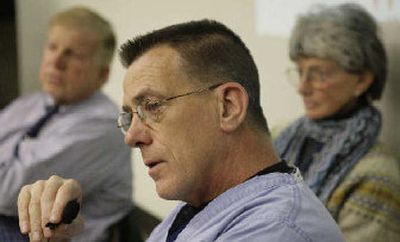
Richardson choked back tears Monday when he described his final minutes with Barbaro. But he emphasized he’d learned a great deal and would be better equipped to handle a horse with the same injury.
“I honestly believe I would have a better chance to save his life, because I would probably not make the same mistakes,” Richardson said. “I’m sure I made mistakes. Everybody makes mistakes, or know of things you could have done better.”