
Earth tones
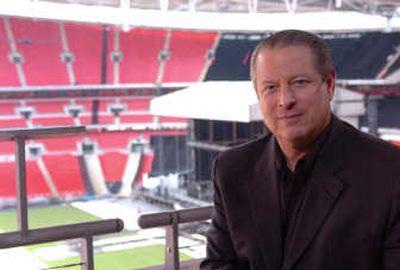
Live Earth is ambitious by any standard: eight concerts featuring the biggest names in music, playing for a 24-hour period across the globe, all for the cause of global warming. But like its template – 2006’s Live 8, the global concert devoted to poverty in Africa – the mission of Live Earth is somewhat amorphous. Its aim is to “trigger a global movement to solve the climate crisis.”
Proceeds will go to the Alliance for Climate Protection, a nonprofit organization chaired by Former Vice President Al Gore (tickets for the U.S. concert range from $83 to $348).
Whatever Live Earth’s accomplishment on Saturday, it will be difficult to measure. Gore, who partnered with Emmy-winning concert producer Kevin Wall to organize the event, believes the people of the world need to rise up as one to influence “a new political reality.”
“The tipping point in the political system will come when the majority of the people are armed with enough knowledge about the crisis and its solutions that they make this cause their own,” Gore says. “Then, you will see the entire political system shift dramatically.”
Wall, who produced Live 8, was inspired to put on Live Earth after seeing “An Inconvenient Truth,” Gore’s Academy Award-winning documentary on global warming.
“The question I kept asking myself is, ‘What can I do?’ he says.
“This concert is not the solution,” Wall adds. “This concert is providing, hopefully, that global tipping point to start to get us into empowering people, get them into the tent.
“Maybe we can make the noise, maybe we can be the town crier, maybe we can say like Paul Revere, ‘The British are coming.’ “
Concerts are scheduled for Giants Stadium in East Rutherford, N.J.; London; Johannesburg, South Africa; Rio de Janeiro, Brazil; Shanghai, China; Tokyo; Sydney, Australia; and Hamburg, Germany.
A band of scientists also will perform in Antarctica, stretching Live Earth across all seven continents.
More than 150 artists will perform, including Madonna, the Police, the Red Hot Chili Peppers and Alicia Keys – not to mention a reunited Spinal Tap.
Sixty short films and 30 public service announcements have been produced. These will be broadcast between performances.
Also planned are more than 6,000 parties in 119 countries, ranging from home viewings to museum festivals.
The concerts will air in the U.S. on NBC, Telemundo, the Sundance Channel, Bravo, MSNBC and Universal HD. They will also be broadcast online at LiveEarth.MSN.com and on XM satellite radio.
Live Earth’s organizers have been mindful of lessons learned from Live 8, which was planned just weeks in advance by Bob Geldof to rally support for Africa.
Envisioned as a sequel to 1985’s Live Aid (which benefited famine in Ethiopia), Live 8 didn’t charge for tickets and generally kept to a vague message urging help for Africa.
The underlying point of Live 8 was to pressure world leaders who days later met for that year’s G8 Summit in Gleneagles, Scotland.
Some success could be claimed: The G8 nations committed to increasing aid to Africa from $25 billion annually to $50 billion by 2010.
The leaders also endorsed a deal to cancel the debt of 18 of the world’s poorest nations.
Since then, Geldof has created a Web site (www.thedatareport.org) to audit how faithfully the G8 nations keep to their Gleneagles promises.
This time around, Gore says organizers are making particular efforts to sustain any momentum gained by Live Earth.
“We’ve listened to the advice of Bob Geldof and others who have been such great pioneers, and we’ve taken their advice in designing this event as not the end in itself, but the beginning of a three- to five-year campaign,” he says.
But Geldof has been critical of Live Earth.
In May, he told a Dutch newspaper: “Live Earth doesn’t have a final goal.”
“I would only organize this if I could go on stage and announce concrete environmental measures from the American presidential candidates, Congress or major corporations,” he added.
At a news conference last week, Gore and Wall mapped out some of their goals for Live Earth.
They unveiled a “7 Point Pledge” that concertgoers will be asked to sign.
Those who sign it promise to pressure their country to sign treaties to cut global warming pollution, personally reduce carbon dioxide pollution, and plant trees, among other things.
Part of the thrust of Live Earth is to communicate what consumers can do to minimize their impact on the environment.
“The problem with it, is that it’s a very complicated issue,” says Wall.
“When you think about yourself recycling a piece of paper, how does that connect to an iceberg in the North Pole?”
Wall and Gore also have taken measures to maintain the concert’s integrity by enlisting the support of the U.S. Green Building Council and John Picard, a former member of President Clinton’s Green White House task force.
Live Earth is intended to be an eco-friendly event with power supplied from renewable energy sources and ground travel from hybrid or high-efficiency vehicles where possible.
“This is going to be the greenest event of its kind, ever,” says Gore.
“The carbon offsets and the innovative practices that are being used to make this a green event, I think, will set the standard for years to come.”
While the former vice president repeatedly has said he will not run for president next year, he says it’s a “main goal” of Live Earth to make climate change an important factor in the election next November and beyond.
“We’re prepared to carry this on for three to five years,” Gore says.
“I’m optimistic that we’ll reach the goal before then.”