
G-rated films relatively rare
Jacquie Wyllie enjoys taking her two children to the movies, but she’s not always happy with the choices.
“I wish there were more G-rated movies,” the Reno, Nev., mother says. “Even ‘Shrek’ and the stuff we go to, it seems like an awful lot of the humor is adult-oriented. … They seem to get further and further away from being funny for the kids.”
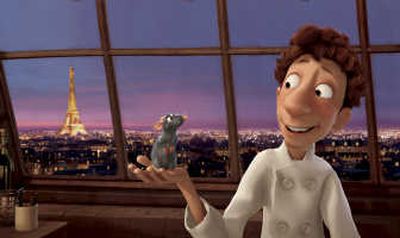
G-rated films have become something of a rarity. In fact, only two of this year’s theatrical releases – “Meet the Robinsons” and the recently released “Ratatouille” – entered the market with a G, the one rating that virtually guarantees that a film is free from profanity, extreme violence and sexual content.
According to the Motion Picture Association of America, only 29 of the films it rated in 2006 received a G. By contrast, 93 received a PG, 191 were rated PG-13 and 539 were rated R.
Those numbers include movies that were rated strictly for direct-to-video use. When you limit the figures to theatrical releases only, things seem even grimmer for the kid-friendly G.
According to BoxOfficeMojo.com, only 12 G-rated movies received a theatrical release last year. That’s fairly typical; BoxOfficeMojo has figures dating to 1982, and at no time during that period have more than 18 G-rated movies been released in a single year.
Only twice have there been more than 15.
Why do so few movies get a G? It depends on whom you ask.
“The immediate response is to go, ‘Oh, you know, we’re just becoming a vulgar society. We don’t care about things the whole family can watch,’ ” says Robert Thompson, director of the Bleier Center for Television and Popular Culture at Syracuse University.
However, he adds, “That certainly isn’t truth. An awful lot of the big box office things are movies that, in fact, are designed for the entire family to go see.”
Ratings stereotype
Thompson believes one reason the G rating suffers is that moviegoers have attached a stigma to it.
“To some extent, I think the G rating is almost the equivalent of suggesting that this (movie) is going to be a Mr. Rogers or Barney singing, ‘I love you, you love me’ kind of thing,” Thompson says. “That G rating might kind of indicate to you that this might be something that’s for the kiddies.”
Thompson isn’t the only one who feels that way.
“I think there’s something in kids, especially the slightly older ones who have some say in what the family is going to go see, that a G-rated film is kiddie stuff,” says Jack Garner, who recently retired as the chief film critic for Gannett News Service. “Plus adults will go only if they have to take a kid.
“But if it’s PG, the adult may be more inclined to go, as they well should with some of these really good animated films.”
Brad Bird, director of “Ratatouille,” “The Incredibles” and “The Iron Giant,” believes that both the G rating and animated films are unfairly ridiculed.
“I always kind of take umbrage when people consider animation a children’s medium because I think that’s a tiny fraction of our audience,” he says.
Bird says his goal as an animated filmmaker is to tell a great story, not worry about the audience or the MPAA rating.
“We like it when kids enjoy the films, but they’re not aimed at kids,” he says. “We make them for ourselves, and we’re not kids.”
That said, “Ratatouille” received a G.
“There was no attempt to make this a G-rated movie,” Bird says. “That just happened to be what it was, and I’m OK with that. … ‘Incredibles’ was PG. I might do an R-rated film someday.”
Comedian Patton Oswalt, who voiced the lead character in “Ratatouille,” says the material – not the rating – is what matters. Much of his comedy is adult, but he says it took zero adjustment to star in a G-rated film.
“I don’t think that R equals funny or relevant, just like I don’t think that G means pointless and silly,” he says. “It’s whatever is good.
“You know, ‘Babe’ was rated G, and I think that movie is way more valuable and resonant to me than ‘Pulp Fiction,’ even though I love ‘Pulp Fiction.’ “
Parental dilemma
Lauren Klein, a Reno, Nev., mother of two, says she’s not an extremist when it comes to what her kids can and can’t watch, but she does keep tabs. And she has noticed that mediums once considered child-friendly are increasingly turning to adult humor.
“They’re not just targeting children any longer,” she says. “They’re trying to make it suitable, with double-entendre and with double meanings, so that they can sell to the adult audiences as well and make more revenue.”
Bird says Pixar, which released “Ratatouille,” does shoot for broad audiences. But it’s artistry, not finances, that inform his filmmaking choices, he says – which is why he’s just as comfortable releasing a G-rated movie as a PG.
And while Bird doesn’t worry about ratings, he says it is possible to make a movie that is high quality and suitable for family viewing. And he would like to see more of them.
“I’m kind of bothered by the fact that there aren’t more things done that kind of are OK for you to go with your whole family,” he says. “I think people think of family stuff as kind of benign and innocuous and wimpy, and I don’t see it that way.
“You know, I love ‘Raiders of the Lost Ark’ and stuff like that. I don’t think it’s wimpy, but it is something I could see with my boys when they were younger and we all had a good time.”
Thompson says there’s little question that the entertainment industry underestimates the market for family-friendly material, and he says financial statements prove it.
“Two of the biggest hits on TV of the 21st century, ‘Who Wants to Be a Millionaire’ and ‘American Idol,’ are among the only two shows of the 21st century on network television that truly are across the board, for the most part, family-friendly,” he says.
What’s more, some of the most profitable films in cinema history were released with a G. “Finding Nemo” and “The Lion King” rank among the 20 highest-grossing films in U.S. history, and both were rated for “general audiences.”
An imperfect system?
Howard Rosenberg, film professor at the University of Nevada, Reno, says ratings don’t much matter – in part because the MPAA system was established nearly 40 years ago, in 1968.
“Children have changed a great deal,” he says. “Have you been to an elementary school lately?
“The things that we were worried about with children years ago? Forget it. They’re so far beyond us, we don’t need this garbage.”
Rosenberg says the only ratings that mean anything to him are G and R because the content of PG and PG-13 films runs from extremely tame to extremely mature.
“I think that the ratings system isn’t working the way that it needs to work,” he says. “It doesn’t really tell a parent anything.”
The solution, says Rosenberg, is for parents to do their own research and vote with their feet.
“If they haven’t got brains enough to figure out what the movie is themselves, then they’re idiots,” he says.
“And if, indeed, they find themselves in that kind of a film (that offends them), they get up and they walk out with their children. That’s the only kind of ratings system and censorship that I really think is effective.”