
Gizmos make iPhone ‘my phone’
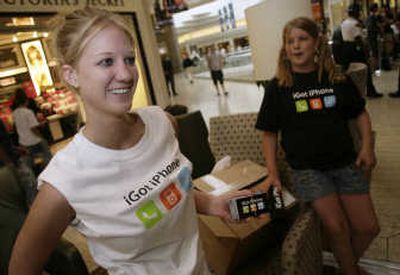
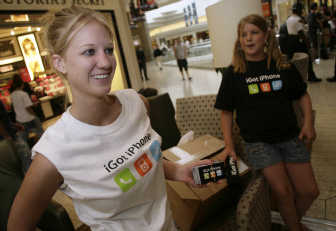
For some cell phone buyers, it’s not what they say, it’s how they say it.
The arrival of the Apple iPhone offers another option for consumers looking to express themselves through their cell phones. For the executive, that expression could mean a holster to carry the phone; for a teenager, it could mean adorning the lid with rhinestones or installing flashing antennas.
“I think definitely in the younger demographic it’s all about form versus function,” said Tiffany Minor, Sprint’s retail sales director in the Pacific Northwest.
As more teens buy phones at younger ages and consumers use them as alternatives to landlines, the accessories industry keeps growing. The options for personalization seem endless.
Many of those accessories are sold by small dealers such as Beyond Cellular, which offers dozens of options for faceplates and accessories at a kiosk in Portland, Ore.
“We sell simple flower color faceplates, some funky ones with dragons and the more designer ones, like Baby Phat. We have different phones for different personalities,” said kiosk owner Brandi Black.
A search on CNET’s Shopper site found 468 faceplates from various manufacturers, with 375 of them costing less than $10. Customers can also buy charms (hanging jewelry), flashing antennas, neon-colored cell phone sleeves and even luxury-branded phones such as the Prada phone by LG.
The branding of the phone can affect its appeal. The iPhone, for example, will carry with it the distinctive Apple white earbuds that are an iPod staple, adding another dimension to the phone as a status symbol. As demonstrated by Apple’s recent commercials in which the Mac and the PC take human form, even electronics can carry a certain identity.
“I think that people are maybe subconsciously drawn to a certain type of product because it looks like them,” said Jared Carter, 25. “My friend, for example, has a phone that is short and flashy, and she’s the same way.”
Carter, a Lake Oswego, Ore., graphic designer, owns two Mac computers, four iPods, and various Mac accessories. He plans to buy the new phone.
“For me, I think a lot of it comes back to being Apple and the types of products they have,” Carter said.
But whether Apple’s branding will affect non-Mac fanatics remains to be seen.
“I think for right now, there is enough competition and volume in the market that it won’t be bland versus cool,” said Neil Strother, an analyst for JupiterResearch, a technology research firm. “Motorola, with their HELLOMOTO, is creating hip devices. I don’t see just Apple as setting the standard. They won’t be alone in terms of style and personality.”
The concept of personalizing gadgets is not new. In the early days of the telephone, just owning a phone was a status symbol. But even early telephones embodied the ornamentation of the Victorian and Edwardian eras, James Katz, a Rutgers University professor, and Satomi Sugiyama, a research associate at the university, noted in a 2005 research paper.
The market these days for mobile-phone accessories, including high-end gizmos such as Bluetooth earphones, will generate more than $32 billion in revenues in 2007, according to research firm ABI Research.
Mixx Inc. decided to target a particular demographic. The company designs and sells mobile-phone purses with funky designs that go for $12 to $15 each.