
Controversial professor dismissed
BOULDER, Colo. – The University of Colorado on Tuesday fired professor Ward Churchill, whose controversial statements comparing victims of the Sept. 11 attacks to Nazis triggered a debate over free speech and scholarship.
CU regents insisted that their decision was unrelated to Churchill’s 2001 essay that called workers in the World Trade Center “little Eichmanns,” a reference to Nazi Adolf Eichmann, who was in charge of sending Jews to death camps.
The regents said they were acting because a faculty committee had found that Churchill, 59, a tenured professor of ethnic studies at the University of Colorado at Boulder, had committed plagiarism and fraudulent research in other writings.
“I’m not sure we had much of a choice,” said University of Colorado President Hank Brown, whose recommendation to dismiss Churchill was upheld by the regents. “The integrity of our research is an integral part of our university.”
Churchill and his backers argued that the move was motivated by a dislike for the leftist professor’s views, and that it would keep other professors from discussing unpopular subjects. “This is a political firing with academic camouflage,” said Tom Mayer, a sociology professor at the university.
Churchill’s attorney, David Lane, said he planned to file a lawsuit in Denver court today challenging the dismissal as a violation of the First Amendment. The message of the university’s action, he said, “is there will be a payback for free speech.”
The controversy began in 2005, when Churchill was slated to speak at Hamilton College in New York. Critics seized on a little-read essay he wrote after the Sept. 11 attacks, titled “Some People Push Back: On the Justice of Roosting Chickens.” In it, he argued that workers in the World Trade Center were “a technocratic corps at the very heart of America’s global financial empire” and compared them to the Nazi leader who carried out superiors’ orders for genocide.
That essay and a follow-up book argued that the terrorist attacks were a response to a long history of U.S. abuses.
Churchill was roundly attacked on the Internet and television, and his speaking engagement was canceled. Several other colleges subsequently canceled appearances by Churchill, but he did speak on the Eastern Washington University campus in Cheney in April 2005.
The University of Colorado’s regents apologized for the essay and the then-governor of Colorado called for Churchill to be fired. He was not, but did step down as chairman of the university’s ethnic-studies department.
The school launched an investigation into allegations that Churchill’s writings on genocide of American Indians involved research fraud. Last year, a panel found several problems in Churchill’s writings, and its findings were accepted by two other faculty panels. In May, Brown recommended Churchill’s dismissal.
Churchill remained on the school’s payroll but has been out of the classroom since spring 2006, first because he was on leave and later because the school relieved him of teaching duties.
After an all-day closed-door deliberation, the regents voted 8 to 1 to accept Brown’s recommendation that Churchill be dismissed. In their motion, they stressed that they supported academic freedom.
“We were guided by the findings of three faculty committees and 25 tenured faculty members,” chairwoman Pat Hayes said of the regents’ decision.
The lone no vote came from Regent Cindy Carlisle, who could not be located for comment.
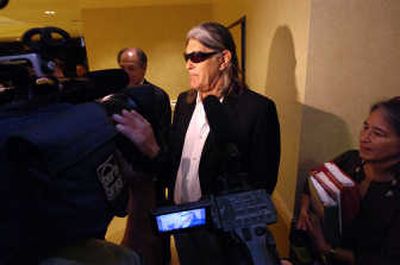
Dozens of Churchill backers, some wearing T-shirts reading “I Am Ward Churchill,” booed and cursed when the vote was announced. At a news conference afterward, Churchill blasted the findings against him as fraudulent and said he was going to stay in Boulder and fight to regain his position.
“I am going nowhere,” he said. “I’ll be here.”