
FBI chief contradicts Gonzales’ sworn testimony
WASHINGTON – FBI Director Robert Mueller Thursday contradicted the sworn testimony of his boss, Attorney General Alberto Gonzales, by telling Congress that a prominent warrantless surveillance program was the subject of a dramatic legal debate within the Bush administration.
Mueller’s testimony appears to mark the first public confirmation from a Bush administration official that the National Security Agency’s Terrorist Surveillance Program was at issue in an unusual nighttime visit by Gonzales to the hospital bedside of then-Attorney General John Ashcroft, then under sedation and recovering from surgery.
Mueller’s disclosure added weight to what until now had been a highly partisan debate on Capitol Hill over Gonzales’ tenure at the Justice Department and his reputation for honesty.
The FBI director’s remarks to the House Judiciary Committee about that contentious meeting differed from testimony earlier in the week from Gonzales, who told a Senate panel that a legal disagreement aired at the hospital did not concern the NSA program. Details of the program, kept secret for four years, were confirmed by President Bush in December 2005, provoking wide controversy on Capitol Hill.
“The discussion was on a national – an NSA program that has been much discussed, yes,” Mueller said in response to a question from Rep. Sheila Jackson-Lee, D-Texas. Mueller also told another lawmaker that he had serious reservations about the warrantless wiretapping program.
His testimony presents a new problem for the beleaguered attorney general, whose credibility has come under attack from Democrats and some Republicans who say Gonzales deceived them on a myriad of topics, ranging from the NSA program to events surrounding the firings last year of nine U.S. attorneys.
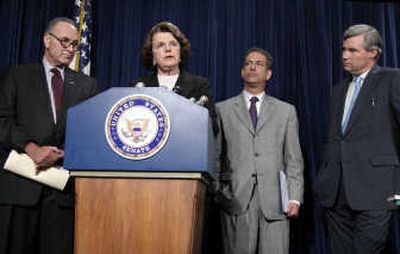
“He tells the half-truth, the partial truth and anything but the truth,” said Sen. Charles Schumer, D-N.Y., as he and three other Democrats on the Judiciary Committee asked the Justice Department Thursday to appoint a special prosecutor to investigate whether Gonzales lied to Congress about the NSA program.
Complicating the administration’s predicament, Sen. Judiciary Committee Chairman Patrick Leahy, D-Vt., Thursday issued subpoenas to White House adviser Karl Rove and one of his deputies, J. Scott Jennings, demanding their testimony by Aug. 2 as part of the panel’s long-running investigation into the prosecutor firings and the alleged politicization of Justice Department career personnel jobs.
The White House has refused previous such requests, prompting House lawmakers to move toward criminal contempt citations against a former Bush legal counsel and his current chief of staff.
Justice Department spokesman Brian Roehrkasse said in a statement that Gonzales’ testimony and statements about the NSA program have been accurate, but that “confusion is inevitable when complicated classified activities are discussed in a public forum.”
Gonzales is particularly under fire for testifying in February 2006 that there had been “no serious disagreement” about the NSA wiretapping program. Gonzales and his aides have said since then that he was referring only to the monitoring of international communications that had been confirmed by Bush, and not to other, undisclosed “intelligence activities” that attracted controversy within the administration.
“The disagreement that occurred in March 2004 concerned the legal basis for intelligence activities that have not been publicly disclosed and that remain highly classified,” Roehrkasse said.
But other officials, including Mueller and several Democratic lawmakers who were briefed on the NSA’s activities, have now said the TSP program, or some part of it, was at the heart of the dispute.
Mueller declined at the hearing to discuss Gonzales’ statements on the topic. “I really can’t comment on what Judge Gonzales was thinking or saying,” he said. “I can tell you what I understood at the time.”
Mueller’s testimony is particularly striking in light of his opposition to Gonzales’ view of the matter at issue during the 2004 legal dispute. Then-Acting Attorney General James Comey sought Mueller’s help in ensuring that an FBI security detail did not evict Comey from Ashcroft’s hospital room during the joint visit by Gonzales, then White House counsel, and Andrew Card, then the White House chief of staff.
Mueller was not present during the hospital visit but testified Thursday that Ashcroft briefed him on the conversation. He repeatedly said he agreed with Comey’s version of events, which included testimony that Mueller, Ashcroft, Comey and others were prepared to quit if the program went ahead without changes to render it legal.
Bush agreed to make the changes after he met with Mueller and discussed the objections Mueller shared with Comey, according to Comey’s account. Mueller conveyed that promise to Comey.
Signaling that Democrats intend to keep pursuing the issue, House Judiciary Chairman John Conyers, D-Mich., wrote to Mueller following Thursday’s hearing requesting notes about the 2004 hospital incident. Mueller testified that he kept records because the episode was “out of the ordinary.”
FBI officials declined to comment.
The White House continued to defend Gonzales on Thursday, and denied Mueller had contradicted the attorney general’s testimony. Presidential spokesman Tony Snow said lawmakers were trying to manipulate the testimony of both Gonzales and Mueller, who he said were limited in what they could say publicly about classified intelligence-gathering programs.
“This is the latest in a long line of artful distortions by people who have spent the last six months hurling allegations at the attorney general. The FBI director didn’t contradict the testimony,” Snow said. “There are attempts in Congress to create a public discussion of classified programs. That’s inappropriate. The president … maintains full confidence in the attorney general.”
The request by four Senate lawmakers for appointment of a special prosecutor was sent to Solicitor General Paul Clement, who has taken charge of all matters relating to the U.S. attorney firings and related controversies because Gonzales and numerous other aides are recused.
Leahy also raised the possibility this week of asking Justice Inspector General Glenn Fine to open a perjury investigation of Gonzales if the attorney general declines to correct testimony that he considers inaccurate.
The subpoenas to Rove and Jennings came one day after the House Judiciary Committee voted to endorse bringing criminal contempt charges against White House chief of staff Joshua Bolten and former White House counsel Harriet E. Miers for failing to cooperate in the investigation of the prosecutors’ dismissals.
The full House is expected to take up the issue after Labor Day, when Congress returns from its August recess. Legal experts said they could not recall a time when both chambers of Congress had simultaneously held administration figures in contempt.