
She’s more than a miracle
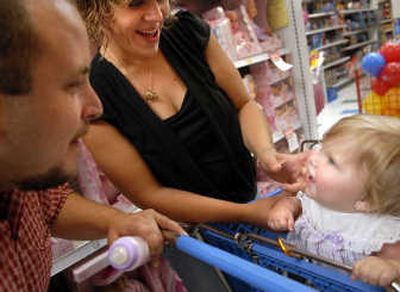
It would be easy to call Rhylee Murrin a miracle child and leave it at that.
In fact, lots of people have used the M-word in the year since Rocco and Jaimasa Murrin’s baby was born with fluid filling her brain – and a hole in the back of her head.
For Spokane physician Dr. Reinaldo Acosta, that was the only hope he could offer for the tiny girl who arrived last July 31 with a baseball-sized mass of brain matter outside her body.
Technically described as an occipital enchephalocele complicated by hydrocephalus, Rhylee’s condition was both rare and dangerous.
“He said if there is a miracle, she could survive,” recalled Jaimasa Murrin, of Clarkston, the mother of Rhylee and two other children younger than 6. “He believes in miracles, obviously.”
As it turns out, though, “miracle” might understate the combination of skill, faith and sheer determination that will culminate today with a blowout party to celebrate Rhylee’s first birthday.
“You get humbled over and over and over,” said Dr. Carl Bodenstein, the neonatologist who treated Rhylee last year at Sacred Heart Children’s Hospital. “That’s nature unfolding itself. If anything, that’s the miracle.”
Now a chubby baby with sandy blond hair and crystal blue eyes, Rhylee has refuted every prediction offered since doctors detected something very wrong during an ultrasound early in Jaimasa Murrin’s third pregnancy.
They detected the encephalocele, literally a hole at the base of the skull through which brain tissue extruded. It’s a neural tube disorder that affects perhaps 1 in 10,000 newborns in North America. The other problem was hydrocephalus, once commonly known as “water on the brain,” a swelling caused by the accumulation of spinal fluid in the spaces of brain called ventricles. It affects about one in 500 children.
“The first doctor we saw was holding the ultrasound picture,” recalled Jaimasa. “I still remember, she said: ‘There’s no easy way to say this, but your baby’s brains are being sucked out of her head. There’s no chance of survival and you might want to think about an abortion.’ Then she handed us a bottle of water and left the room.”
Stunned, Rocco, 31, a plumber, and Jamaisa, 29, a homemaker, considered their options.
“I don’t believe in abortion unless it’s a serious matter,” said Jaimasa Murrin. “I thought, as long as she’s moving in my stomach, she was telling me: ‘Give me a chance.’ During my pregnancy, there were days when I thought about aborting her, but I couldn’t bring myself to do it.”
Instead, she carried the pregnancy to term, knowing all along that the baby might not survive birth.
“We were all waiting for this deformed baby to come out all limp,” she said. “She came out kicking and screaming and ready to go. The whole room started crying. We were all crying. We sounded like a bunch of babies, too.”
Doctors immediately inserted a shunt to drain fluid caused by the hydrocephalus. Born weighing 7 pounds, 3 ounces, Rhylee weighed just 6 pounds when the fluid was removed.
The Murrins knew that if Rhylee lived, she likely would be severely disabled. But they said that prospect wasn’t daunting, partly because Jaimasa Murrin has spent years caring for disabled people as the manager of group homes in New Jersey.
That wasn’t the only reason, though.
“They may be severely disabled, but they’re still your child,” Jaimasa Murrin said. “I would rather have her here and care for her the rest of her life. I would rather have seen her for one second than not have seen her at all.”
The decision hasn’t been easy. Rocco Murrin recently switched jobs, and money is tight. There’s 5-year-old Trinity to consider, and 3-year-old Logan. The couple said they haven’t added up the medical bills Rhylee has incurred in Spokane, but they figure the total has mounted into hundreds of thousands of dollars, even with coverage through Washington state Medicaid.
“We had to pawn my rings in order to have money to have gas and pay for hotel rooms while she was in the hospital all last summer,” Jaimasa Murrin recalled. “We’ve had to borrow until we’re blue in the face.”
The debt, however, pales compared to the reward of raising Rhylee, they said. Now a sturdy 30-pound girl, Rhylee sports a cowlick of hair over the open spot in the back of her skull and the shunt site on the side of her head. The small hole in the back of Rhylee’s skull will remain open, at least for now. Skin covers the soft spot, but the bone won’t grow together. Doctors could patch it, but after two previous brain surgeries, they’re leery of subjecting the child to more stress until it’s necessary.
At age three months, a scan indicated Rhylee had only 10 percent of the brain matter expected for a child her age. By nine months, that had increased to 85 percent, her parents said.
Rocco and Jaimasa Murrin believe that Rhylee’s brain regenerated itself. Bodenstein, the neonatologist, said that’s not possible. More likely is that after the fluid was removed, Rhylee’s existing brain rebounded to fill the space.
“It’s really what we would expect after a shunt,” he said. “It’s really a matter of how the brain is laid down in the skull, how well these kids do.”
So far, Rhylee has done quite well. She smiles and laughs, hugs her mom, holds her own bottle. Her vision remains erratic because of the pressure of the fluid that surrounded her brain, but otherwise there are no outward effects.
“You wouldn’t honestly know that she has issues,” Jaimasa Murrin said. “The only thing they can say is that she’s three or four months delayed. After she’s 2 years old, we’ll know for sure.”
In that respect, Rhylee is like so many of the very ill babies treated in the neonatal intensive care unit, Bodenstein said.
“We take care of kids born with their guts laid out, their brains laid out, their hearts laid out, you name it,” he said.
Many, many of those children not only survive, but thrive, despite the very dire predictions offered by medical experts.
“The ability to predict is very, very poor in these kids,” Bodenstein noted. “If you don’t give them a fairly pessimistic perspective, you’re doing a disservice.”
By that standard, Rhylee’s recovery is no rarity. Instead, she’s simply a strong, feisty child with loving parents – and a will to live.
“If I believed in miracles, this wouldn’t be the miracle child,” Bodenstein said. “This kid is going to do whatever she wants to do.”