
Bush welcomes British leader
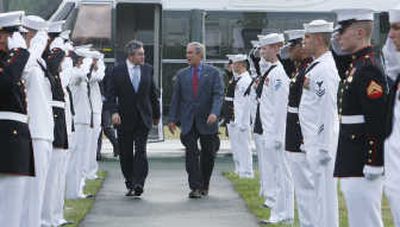
CAMP DAVID, Md. – President Bush, starting a new relationship late in his presidency, welcomed British Prime Minister Gordon Brown on Sunday with casual diplomacy.
In the tranquility of the Catoctin Mountains, Bush and Brown began their brief meeting – Sunday night and today – at Camp David, with an emphasis on private time between the two. Their substantive agenda is familiar: terrorism threats, wars in Iraq and Afghanistan, the crisis in Darfur and stalled trade.
Yet the overarching theme is rapport – and establishing some.
Bush is aiming for at least a solid relationship with Brown, shaped around their nations’ mutual interests. That much is expected, but it is far from the kinship Bush had with Brown’s predecessor, Tony Blair, who lost favor at home because of his close ties to Bush.
Brown arrived by helicopter at Camp David after thunderstorms gave way to sunshine. He emerged to find a military honor guard and Bush waiting for him.
“It’s a great pleasure to be here at Camp David because there’s so much history associated with it,” Brown told Bush as the leaders exchanged small talk.
Bush drove the two of them away in a golf cart after doing a playful 360-degree maneuver in front of the gathered media. The two were off for a private dinner.
En route to the United States, the new British leader said the world is indebted to the United States for taking the lead in the fight against terrorism. Brown said he would use his visit to strengthen what Britain considers its “most important bilateral relationship.”
London and Washington are focused on “the biggest single and immediate challenge the world has to defeat: global terrorism,” Brown told reporters traveling with him.
“America has shown by the resilience and bravery of its people from Sept. 11 that while buildings can be destroyed, values are indestructible.”
Brown denied speculation that Britain’s relationship with the U.S. was cooling. His predecessor, Blair, was often accused at home of being too compliant with Bush’s policies, especially regarding the Iraq war.
Brown arrives with some thorny issues to manage, not least the fate of Britain’s remaining soldiers in Iraq.
In Washington, officials expressed optimism about ties between Bush and Brown, but there has already been friction.
Junior foreign affairs minister Mark Malloch-Brown raised eyebrows in Washington recently when he said Bush and Brown would not be “joined at the hip” – a jab at Blair’s close relationship with the U.S. president.
In London, the Sunday Times reported that Simon McDonald, Brown’s chief foreign policy adviser, recently traveled to Washington to meet with U.S. officials ahead of the prime minister’s visit and discussed the possibility of an early British military withdrawal from Iraq.
Around 500 of Britain’s 5,500 troops in Iraq are due to hand over the Basra Palace city center base within weeks, defense officials have said. Brown has not outlined plans for the remaining 5,000 personnel, stationed at an airport on the fringes of the city.
Other difficult issues include the American push to build a missile defense system in Eastern Europe, the Iran nuclear showdown, Darfur and the status of the breakaway Serbian province of Kosovo.
Aides said the British leader aimed to secure Bush’s help in restarting the stalled Doha rounds of World Trade Organization talks, which seek to help poorer countries develop through new trade. He also wanted to discuss a stiffer international response to the violence in Sudan’s Darfur region.