
Creationism defended
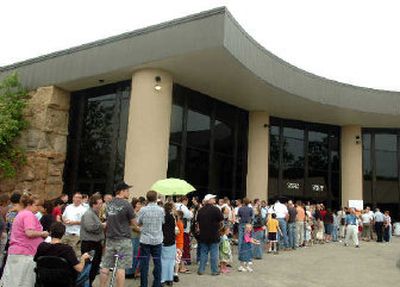
PETERSBURG, Ky. – Ken Ham stood outside his $27 million Creation Museum before its official opening on Monday and declared its mission is not just to counter evolution.
He also wants to create a few Christians.
“We don’t just want to see people converted to creationism,” said Ham, president of the Answers in Genesis ministry, which built the museum.
“We do want to see people consider the claims of the Gospel, the claims of Christianity, to see people put their faith and trust in the Lord Jesus Christ.”
The latest juncture between evolutionists and creationists comes in the form of a 60,000-square-foot building whose main hall features animatronic dinosaurs and figures of young children playing near each other in a way its owners believe life really occurred some 6,000 years ago.
With the slogan “Prepare to Believe,” Ham’s creation-defending ministry opened the museum on Memorial Day on 49 acres just over the Kentucky state line from Cincinnati, a site officials say is a convenient travel distance for two-thirds of all Americans.
The museum was partially funded by three anonymous families who donated $1 million each, but 75 percent of all donations averaged around $100. Those donations built a state-of-the-art museum with vibrating seats and sprays of water in a theater that depicts Noah’s flood, and extensive exhibits that claim the Grand Canyon could have formed around the time of that flood rather than millions of years ago, as suggested by most scientists.
A studious visitor could spend several hours in the museum, which includes a planetarium, exhibits detailing the construction of Noah’s Ark, and life-size sculptures of Eve handing Adam the forbidden fruit from the Garden of Eden.
Two days before the official opening, a supportive crowd of hundreds of civic and business leaders and charter members – some who paid $1,000 for a lifetime membership – dined on shrimp and fruit kabobs after a ribbon-cutting ceremony.
Critics, however, were not far away: A plane from the group Campaign to Defend the Constitution (DEFCON) circled overhead flying a banner that read, “DEFCON says thou shalt not lie.”
Atheist and scientific groups have signed petitions complaining that the museum fosters “superstition” and will confuse schoolchildren who see one view there and hear another in high school and college.
“The ‘museum,’ as it’s called, is part of a campaign to deceive children and undermine scientific understanding in our country,” says Clark Stevens, co-director of DEFCON.
Russell Moore, dean of the School of Theology at Southern Baptist Theological Seminary, disagrees. He traveled from Louisville, Ky., with his wife and four young children to the ribbon-cutting ceremony.
“I want to raise children who are able to understand Darwinism and to be able to see the alternative to it,” said Moore, a proponent of creationism.
“We have a biblical text that reveals the universe as it is, and I believe in raising children who understand the authority of the word of God and who also understand all of the alternatives … and are able to make informed, educated analysis of those things.”
One room in the museum features two paleontologists – both as sculptures, and as actors in a brief video – examining dinosaur bones. One declares them to be thousands of years old; the other says they are millions of years old.
The first paleontologist appears again in the last theater presentation, Bible in hand, declaring that every word of the holy book is true.
Just outside that last theater, members of a “CARE team” are ready to answer questions about the video, which begins with the paleontologist holding the bone of an ancient animal and ends with the story of Jesus’ resurrection.
The team’s acronym stands for Compassion, Acceptance, Respect and Encouragement, said Cecil Eggert, the museum’s “creation evangelism” director.
He said the 30-member CARE team, which was trained over several weekends, will offer everything from informative pamphlets to praying with someone who has decided to become a Christian.
The biblical message will extend to the gardens of the museum, which feature sculptures of Tyrannosaurus rex and herons along with waterfalls and bridges over a man-made lake. Signs will link nature to the Bible.
“People who come just to the gardens are going to get the Gospel,” says Tim Schmitt, the museum’s horticulturalist.
John Haught, a research professor at Georgetown University who is an expert on science and religion, says it’s “not terribly surprising” that a museum would be created to shore up creationists’ arguments about the origins of life.
“It’s important for them to deny evolution because … if evolution happened, then there was no original perfection,” says Haught, a Roman Catholic who believes in evolution. “It’s absolutely essential for them that there be some fall. Otherwise the whole significance of Christianity gets lost.”
Museum founder Ham, who once was a science teacher in his native Australia, says the museum’s exhibits on creation explain the basis of the Christian faith by linking the first sin by Adam to the sacrifice of the “last Adam,” Jesus.
“If you want to go and tell someone about Jesus Christ and about sin and about the need for repentance … you really can’t do it without the foundational history of Genesis,” he says.
“Without the history of Genesis, you have no basis for any Christian doctrine.”