
It’s a matter of PRIDE
You’ve come a long way, baby.
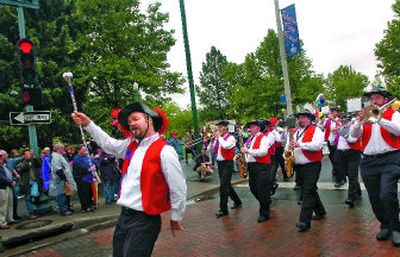
When Spokane’s Pride Parade was born 16 years ago, the procession was a low-key affair that lasted only half an hour. About 400 people showed up that year, belting out chants – “We’re here, we’re queer, we’re fabulous. Get used to it!” – while marching just a few blocks on a quiet Sunday afternoon.
Participants were described as “demonstrators” in news accounts that year. Many didn’t want their names published in the paper. “I guess I didn’t realize there were so many of them,” one passer-by said in an article that ran the day after the parade.
The crowd size – and energy – dwindled over the years, especially when the parade moved to the outskirts of downtown.
In recent years, however, the annual gathering that drew mainly hard-core activists and a smattering of drag queens has gained momentum again and evolved into a communitywide celebration – an event with a county-fair flair right in the middle of downtown Spokane.
Thousands of people are expected to attend next Saturday’s Pride Parade and Rainbow Festival, which has grown to include a family play area with bouncy castles and games, live stage entertainment and even a baking contest.
The festivities started Friday with a film festival and continue through this week with a variety of events, including the Rainbow Awards, a game night and a forum with Grethe Cammermeyer, the retired Army colonel who successfully fought to stay in the Washington National Guard despite the military’s policies.
Contrary to some stereotypes about the gay and lesbian community, the Pride Parade has never been about sex, said Bonnie Aspen, a board member of OutSpokane, the nonprofit that organizes the annual gathering.
“It’s a cultural celebration for the entire community,” she said.
And while the parade still includes the drag queens attired in stunning evening gowns and precariously high heels, the gathering is like many other major events in Spokane: It’s designed for families.
“I want my daughter to value everyone,” said Darlene Palmer, who has brought her 4-year-old daughter, Chloe, to the parade from the time she was an infant. “It’s important for us to be out here, that we have nothing to hide and that we’re all humans and we should all be appreciated.”
As part of this year’s Pride celebration, OutSpokane launched a three-stage billboard campaign that started in early May.
The billboard features the Riverfront Park clocktower and 14 individuals who represent the diversity in Spokane.
The campaign started out with the first message: “Hi Spokane! We’re your friends, families and neighbors.”
In mid-May, they added a second sentence: “Some of us are gay.”
On Friday, the final stage entailed these words: “All of us deserve equal rights!”
The same billboard campaign was banned in Atlanta two years ago, said Christopher Lawrence, co-chair of OutSpokane. Locally, organizers have received no complaints so far.
That’s a good sign for Spokane, a community where many in the GLBTQ – gay, lesbian, bisexual, transgendered and questioning – community remain in the closet, said Lawrence.
While some still experience discrimination, more people feel safe about being out, he said.
“It’s just been a matter of visibility,” explained Aspen, who celebrated her 28th anniversary with her partner, Willow Williams, this year.
“The more visible people are, the more the community becomes aware that the little old lady down the street who brings in their mail when they’re on vacation happens to be a lesbian. And she bakes wonderful cookies. …
“Spokane has a conservative reputation, but it’s a welcoming community.”
Aspen, Lawrence and others say that the parade and other Pride events remain essential in order for the people to realize that gays and lesbians are very much part of the community fabric.
They also want to move toward their goal – “where being gay is a no-thing,” Aspen explained, that sexual orientation is only one aspect of who they are as a person.
“My mission is for people to live authentic lives,” said Lawrence, who designed the OutSpokane billboard campaign.
When Palmer, 27 and a native of Spokane, first spotted one of the billboards on Washington Street in north Spokane, she was overwhelmed with emotion. “My heart just filled with joy and I got all giddy,” she said.
For Mother’s Day, she asked her husband, Chris, to drive her and Chloe around town so she could see all seven billboards.
“You look at them and you see people from different professions in Spokane,” she said.
“And yes, they are my friends, my family and my neighbors. They’re everywhere.”
Palmer, who is bisexual, wants her daughter to be open about her sexuality when she gets older – regardless of her orientation.
“I want her to see that it is OK to be the person she is,” she said.
“By going to Pride with me, she sees that this is not a taboo topic in our home and can feel free to come to Chris and I knowing we will fully accept her.”