
Sharp eyes lead Qwest to vow refunds
Thousands of Qwest long-distance customers in Spokane County will be getting refunds for utility taxes they didn’t owe, and the state Utilities and Transportation Commission wants to know why.
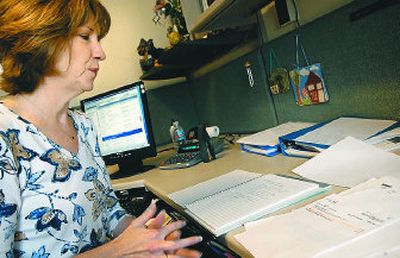
The short answer is that Spokane County budget analyst Margaret Smith didn’t pass the buck when a county resident called her last July with a question.
Instead of telling the man to call Qwest about his bill, Smith dug into his complaint about being charged the wrong sales tax rate and discovered that he also was paying a city utility tax even though he didn’t live in a city.
Many questions remained unanswered Thursday about whether the problem, attributed to a nationwide information service company, may have occurred elsewhere.
Smith spent nearly a year working with Qwest officials to arrange the utility tax refund that will appear on customers’ bills this month or next. The refunds will go to all of Qwest’s long-distance and DSL Internet customers in unincorporated Spokane County.
It took two calls, three e-mails and a letter to get Qwest managers’ attention, but “they were good about working with me to get this resolved,” Smith said.
“It did take longer than I might have wished,” she said. “Oh, my gosh, yeah. Longer than Qwest wished, too, I can tell you that. I think it was just a little more difficult to pull out all the data than we expected.”
In all, 11,698 customers are to share a $42,835 refund for two years of utility taxes they didn’t owe on their long-distance service – an average of $3.62. Refunds for DSL customers haven’t been calculated yet but are expected to affect fewer people. Smith is negotiating refunds for people who were charged too much sales tax.
“This isn’t a lot of money, but it’s the principle,” Smith said. “I want taxpayers paying only what they should be paying.”
The Washington Utilities and Transportation Commission launched an investigation Thursday after receiving an inquiry from The Spokesman-Review.
“We are particularly interested in understanding how long this has been happening and how the tax has been wrongly collected,” utilities commission spokeswoman Marilyn Meehan said.
The refund reflects only the portion allowed under the two-year statute of limitations.
Meehan said the state regulatory agency also wants to know how the refunds are being calculated and what Qwest is telling its customers.
“We want customers to check their back bills to make sure they’re getting the correct amount,” Meehan said.
This is not the first time Qwest has bungled tax collections. The Tacoma News Tribune reported in April that Qwest had been charging its Lakewood, Wash., customers a utility tax rate of 6.382 percent even though the correct rate was 6.0 percent.
As in Spokane County, a keen-eyed customer cut through the fine print most people ignore on their bills. Efforts to reach Spokane County’s eagle eye for comment Thursday were unsuccessful. Smith didn’t want to name him without his permission, but left messages on his home and cell phones.
In Lakewood, city officials agreed to pay refunds they said might total $200,000, according to the News Tribune. Municipal spokesman Jeff Brewster said Qwest apparently followed its practice in other cities of charging extra to cover the cost of collecting the tax, but Lakewood ordinances didn’t allow padding.
Smith said Qwest executives declined to tell her which Spokane County cities will be affected by the company’s utility tax error here. Five cities – Spokane, Airway Heights, Cheney, Deer Park and Latah – all levy a 6 percent utility tax on long-distance bills.
The tax is on phone companies, not their customers, but the companies are allowed to recover the money from their customers.
Qwest spokeswoman Shasha Richardson said the Spokane County problem is isolated, but she couldn’t explain how it occurred.
“I believe it came from the third-party vendor that’s used, not just in our region, but thousands and thousands of counties and cities provide information to a software provider that many businesses use,” Richardson said. She said the company, Vertex, is believed to have supplied incorrect data.
No spokesman was available Thursday afternoon for Vertex, which is based in Berwyn, Pa., and had closed for the day.
“There was an inaccuracy in the software,” Richardson said.
But the only explanation she could offer was that “it has to do with how information is coded, what’s input, what’s provided, what the output is.”
Asked how Qwest managed to collect city taxes on people who don’t live in cities, Richardson said, “What our understanding is, is that it relates to the product.”
Nevertheless, Richardson insisted the problem is isolated to Spokane County.
“The good news is that this was identified,” she said.
Meehan said the utilities commission has no jurisdiction over Vertex but wants specific information about the problem and Vertex’s possible role.