
Memorializing Mann Gulch
There’s a canyon on the Missouri River 20 miles north of Helena that has a special meaning to wild land firefighters, especially smokejumpers. To those parachuting firefighters, that canyon, Mann Gulch, is sacred ground.
It was there on Aug. 5, 1949, that a fire blew up and overran 13 men, 12 of them jumpers. Two smokejumpers, Bob Sallee and Walter Rumsey, outran the fire and escaped into the next canyon north, now known as “Rescue Gulch.”
Their foreman, Wagner “Wag” Dodge, built an escape fire, then lay down in it as the main fire burned over and around him. He was unscathed.
William Harrison had been a smokejumper during the previous two fire seasons. He’d foregone the 1949 jump season because his mother thought parachuting to forest fires was too dangerous, so in 1949 he signed on as a fire guard on the Helena National Forest.
From his duty station at the Meriwether Campground in the next canyon to the south, Harrison hiked up Meriwether Gulch then dropped down into Mann Gulch, there to die with his old comrades.
The death of those 13 remains the greatest single loss suffered by the smokejumper organization, now in its 67th year.
The tragedy was recounted in the 1992 best-selling book “Young Men and Fire” by the late Norman Maclean, a Forest Service veteran, Montana native and University of Chicago English professor.
The U.S. Forest Service, which manages Mann Gulch in what is now the Gates of the Mountains Wilderness, has erected small granite obelisks where each man fell. Those monuments are replacing concrete and rebar crosses which were placed soon after the fire but are now deteriorating. In August 1999, during the 50th observance of the tragedy, the Forest Service also erected a monument to the fallen at the Meriwether Campground. It consists of a bronzed smokejumper jacket and helmet and a listing of the names of the dead and their hometowns.
Now enter members of the National Smokejumper Association, most retired from that job, many in their 60s and 70s. They want to help the Forest Service memorialize the area where their predecessors died.
For the past eight years, the NSA has provided volunteers for a variety of tasks the Forest Service has needed but does not have the money or manpower to accomplish.
With the assistance of backcountry horsemen’s associations whose members pack in supplies to the crews, NSA volunteers have rehabilitated 703 miles of trail and eight backcountry cabins, built or restored eight bridges, restored two fire lookout towers, and erected six miles of wooden fence.
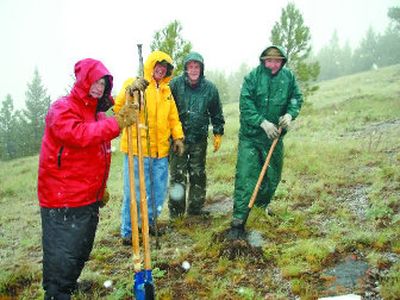
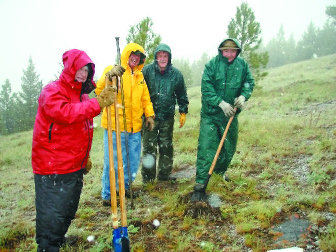
During a recent rainy and snowy 40-degree pair of days, a group of 14 volunteers, former smokejumpers and associate members of the association, pitched their tents near the Meriwether fire guard’s cabin, then went to work.
Packers from the Last Chance Back Country Horsemen delivered to the ridge between Meriwether Gulch and Mann Gulch tools, cement and a sign that described the 1949 jumpers’ ordeal.
Ten of the volunteers climbed the switchback trail to the ridge, then in blowing snow, dug postholes and planted the sign. From it, visitors will learn the actions of the ill-fated crew and the point where each man was overrun. The sign also carries pictures of the survivors and the names of the dead.
On their way back down to their camping area, the volunteers repaired trail washouts and felled trees that threatened to fall over the path.
Two other former jumpers found each of the monuments where the men fell and marked those locations with a global positioning unit to ensure that the spots are preserved for history.
And two other former jumpers reconnoitered the trail from the bottom of Mann Gulch on the Missouri to the dead men’s monuments.
Jon McBride, chief of the NSA’s trail operation, said his organization is willing to help the Forest Service it can to ensure that Mann Gulch is preserved and protected.
If the Forest Service agrees, that could include building a trail that would connect the monuments, he said.
In a note to the jumpers, Jeff Brandt of the Helena horsemen said, “I’m humbled by your efforts to honor your fallen comrades. I first hiked through the markers over 20 years ago and didn’t understand fully what happened. The sign will be an important educational tool. Now I have to read the books written on the incident so I fully understand.”
And, from Jaime Tompkins, the outdoor recreation planner for the Forest Service’s Helena District: “The sign was placed in an ideal location. It has already been seen by dozens of schoolkids that have taken a trip out there since you and the members of the National Smokejumper Association completed the work.
“You and your organization are to be commended for the outstanding work.”
Before returning to their homes, the volunteers paused for an informal ceremony at the Meriwether Campground memorial. One of the crewmen, Jim Phillips, reminded the group that the 13 men who died in Mann Gulch left a legacy: Their deaths led to the initiation of scientific studies of wildfire, the incorporation of 10 standard firefighting orders and the delineation of situations that cry “watch out.”
Those include references to the weather, terrain, communication, safety zones and escape routes.
Wild land firefighting remains dangerous but, because of the sacrifice of 13 young men at Mann Gulch, it is far safer now than it was on Aug. 5, 1949.