
Bush again vetoes stem cell bill
WASHINGTON – The public disagrees with him. Congress is against him. But when it comes to embryonic stem cell research, President Bush isn’t budging – although he’s trying not to look inflexible.
Bush was on familiar ground Wednesday, vetoing a stem cell bill with an appeal to the sanctity of human life.
But this time, he sought to placate his critics by signing an executive order urging scientists toward what he termed “ethically responsible” research in the field that holds the promise of curing disease.
The president announced no new federal dollars for stem cell research. His order would not allow researchers to do anything they couldn’t do under existing restrictions. But his order encourages scientists to work with the government to add other kinds of stem cell research to the list of projects eligible for federal funding – so long as it does not create, harm or destroy human embryos.
“We want to encourage science. We want to say, ‘We stand on your side in an ethically responsible way,’ ” Bush said.
“I invite policymakers and scientists to come together to speed our nation toward the destination we all seek – where medical problems can be solved without compromising either the high aims of science or the sanctity of human life.”
Democrats denounced Bush’s veto as a moral affront, and his executive order as a meaningless gesture meant to trick people into thinking he had advanced stem cell research. They said they would hold votes to try to override the veto – or at least give the issue more air time.
“We also intend to continue bringing this up until we have a pro-stem cell president and a pro-stem cell Congress,” said one of the House’s chief sponsors, Rep. Diana DeGette, D-Colo.
Senate Democrats were expected to begin the process by trying to attach embryonic stem cell legislation this week to a must-pass appropriations bill for the Labor and Health and Human Services departments.
The provision, proposed by Sen. Tom Harkin, D-Iowa, would allow taxpayer dollars to be spent on research on human embryonic stem cell lines derived before June 15, 2007 – moving the date of Bush’s ban on public funding for such research up by nearly six years. Research on stem cell lines derived in the interim would be eligible for federal funding. The new provision also would add ethical standards to be used for selecting embryos to be studied, according to a draft of the provision.
Public opinion polls show strong support for the research.
Republican presidential hopefuls are split on the scope of federal involvement in embryonic stem cell research. Sen. John McCain of Arizona and former New York Mayor Rudy Giuliani have broken with Bush – and the GOP’s social conservatives – in backing the expansion of federal funding for such research.
Rivals Mitt Romney and Sen. Sam Brownback of Kansas oppose the expansion.
Most of the Democratic candidates have urged Bush to expand the research.
The president is “deferring the hopes of millions of Americans who do not have the time to keep waiting for the cure that may save or extend lives,” said Democratic presidential hopeful Sen. Barack Obama of Illinois.
Sen. Hillary Clinton, D-N.Y., said if she is elected president, she will lift restrictions on stem cell research.
“This is just one example of how the president puts ideology before science, politics before the needs of our families,” she said.
Bush urged support of legislation sponsored by Sen. Norm Coleman, R-Minn., which passed the Senate but has not yet been taken up by the House. Coleman says his measure supports federal funding for embryonic stem cell research methods that do not harm embryos. “It provides for ethically responsible stem cell research sooner rather than later,” Coleman said.
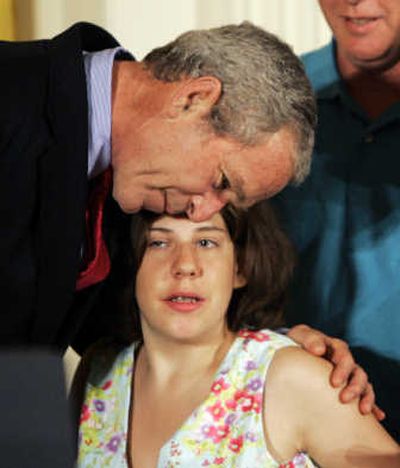
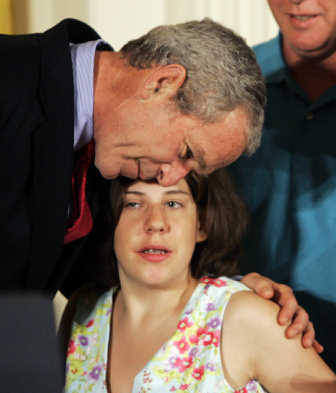
“Destroying human life in the hopes of saving human life is not ethical, and it is not the only option before us,” said Bush, who appeared on stage with Kaitlyne McNamara, of Middletown, Conn., who was born with spina bifida, and is benefiting from what he called “ethical stem cell research.”
Sean Tipton, president of the Coalition for the