
Collectors all buttoned up
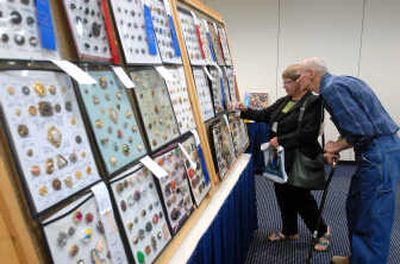
It’s a fierce world, button judging. You wouldn’t know it from the white-haired women clustered around trays of ornamental objects, but discerning eyes eliminate the decoys, the mislabeled and the duds at the 32nd annual Idaho State Button Show.
Then these rejects are perched on display, marred with a pink heart sticker, and called “measles.” The losing trays stand along with the winners in rows of buttons from mom’s sewing kit to those dating back from the Colonial era. There are even buttons carved out of peach pits, all viewable today in Coeur d’Alene.
“If you make a mistake you get a little love dot,” warned National Button Society Vice President Joan Lindsay, 66, referring to the stickered losers who fail to follow the rules in the classification handbook. A bronze Egyptian Pharaoh button does not fall into the Oriental category.
“But look at that! It’s easy to get hooked,” Lindsay said, eyeing an assortment of intricately carved jade and pearl buttons.
Her button passion grew out of a search to find something light and transportable to collect, as her husband’s Army job involved frequent moving. Buttons could fit in a box or, as the collection grew, a closet.
Thousands of button trays are laid out at the event, with each falling into a specific category and fitting about 25 buttons. Categories range from the type of material, like gourd and celluloid, to themed trays with 1940s style buttons or pastoral scenes. Judges, who lean over the trays with magnifying glasses, select one winner from 25 categories. Buttons range from the Wal-Mart $1 plastic variety to Civil War memorabilia that can fetch up to $20,000.
While it’s not possible to purchase the pine needle button, the 1849 oversized granite broach or the others inside the trays, collectors turned dealers will sell some of their wares today. Most will cost more than the prize money – $3 to $5 for first place in each category.
“Once you start collecting you never look at buttons the same,” said Diane Cox, 56, peeking past the judges to examine a tray of intricately carved abalone shell bottoms. The Twin Falls nurse scavenges for forgotten buttons at yard sales, antique stores and even farmers markets. “My friend said this was silly, then she saw this show and now she can’t go anywhere without looking for buttons,” she said.
Cox’s passion for collecting stemmed from her mother, who is also attending the event, which is expected to attract up to 50 dealers and collectors from as far as Seattle and Salem, Ore.
The National Button Society has about 3,000 members from around the world. Idaho has four local clubs scattered around the state, but no junior league like in some places.
Don’t let that fool you, said Cox, who even introduced her 2-year-old granddaughter to the button world’s subculture. “She goes around the house saying, ‘Buttons, buttons!” she said with a chuckle.
Cox admits to a personal fetish for any button with a buckle on it. “There’s a history behind them,” she said. “They tell a story.”
One of the founders of the Idaho Button Society, Joan Beamish, 81, from Harrison, considers them more than historic artifacts. To the former potter, they are miniature works of art.
“You should see the porcelain ones made in Japan,” cooed Beamish, a self-proclaimed button addict for almost half a century.
But there’s a fine line between obsession and pleasure, even for those truly dedicated to collecting, said Anne Geaudreau, 79, the awards chairwoman this year. “Once I saw a button with a wisdom tooth in it,” she said, glancing at the button treasures from this year’s show. “It just made you sick.”