
Injury keeps fencer from sport she loves
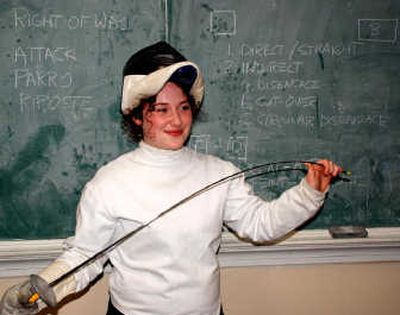
At 5 feet tall, Carolyn Travis doesn’t seem like an intimidating person. Put a foil or a saber in her hand, though, and the 17-year-old Hayden Lake native terrorizes even men who have more than a foot on her.
Travis competes in the Olympic sport of fencing, a sport she picked up 3 1/2 years ago after seeing “Pirates of the Caribbean” and signing up for classes with a friend. Though the curly-haired high school junior enjoys other sports – softball, basketball and running – fencing has captivated her.
“I loved it immediately,” Travis said. “It’s a very physical game. You get such an adrenaline rush every time you’re out there. It’s also a mental game. It’s like chess in that you set up your moves.”
She fences at Coeur d’Escrime, a club in Coeur d’Alene, where she attends practices three times a week.
“She has a natural aptitude for it,” said fencing coach Jessica Brower. “I think she has a lot of characteristics that you see in fencers: analytical ability, perfectionism. She’s physically very fast, and she has very good footwork.”
While she lives in Hayden Lake, Travis attends The Oaks, a private classical school in Spokane. With her daily commute, her interests in photography, drawing and reading, piano lessons and hours of homework every night, Travis doesn’t have a lot of free time. But she’s always ready for fencing.
“One of the greatest things about coaching her is that enthusiasm,” Brower said. “She smiles. Her eyes sparkle. She lights up! It’s great to have a student who has that much passion in what she does.”
Christie Travis, Carolyn’s mom, noticed the attraction to the sport right away, but she said Travis’ dedication isn’t surprising.
“Carolyn is different than most people I’ve experienced,” Christie said. “The things she thinks about, dreams about, she puts into action.”
Travis said she hopes to fence in college, possibly earning a scholarship to compete for a school like Northwestern, Penn State, the Air Force Academy or New York University. In order to attract recruiters, Travis qualified in foil and saber for the Junior Olympics, a 20-and-under tournament that features some of the best fencers in the country – of any age – that’s held every February.
However, while at a warm-up tournament in Seattle in January, Travis injured her knee during a foil bout. She took a step back to avoid an attack and when she came forward again, she collapsed.
“I was really confused. I thought someone had kicked me from behind or something,” Travis said. “It was the worst pain I’ve ever experienced.”
Back at home, the doctors initially told her it was a bad sprain until the MRI results came back. Then they found out she’d torn her anterior cruciate ligament, a connector inside the knee that keeps it from moving back and forth.
“My mom was in tears,” Travis said. “I’d severed my ACL, torn my meniscus. I was so sad, I cried. I normally don’t cry, but I cried.”
With the injury, Travis lost the opportunity to fence at the Junior Olympics and the Summer Nationals held in July. Instead she faced an arduous recovery that would extend into the fall.
“It’s gonna be a long haul – eight months,” she said.
Since her reconstructive surgery in March, Travis has regained much of her range of motion and is now working on strengthening her atrophied quadriceps muscles. She still attends practices just to be around the sport, and she helps out by giving lessons. She also drills her blade work and point control, practicing the fine hand movements that control the weapon.
“We’re trying to make it not eight months of lost time,” Brower said.
Travis said she gets depressed being on crutches because she’s more dependent on others and can’t do many of the activities she’s used to doing. Previously, she’d injured her rotator cuff, which kept her from playing softball.
“When I had the shoulder injury, I still had my left hand, so I fenced left-handed for six months,” she said.
This time, she’s forced to sit idle. She said she’s been reading a lot of books, watching movies, drawing and exploring photography with the digital camera she saved up for.
“I can tell it’s frustrating for her,” Christie said. “She doesn’t verbalize it; she’s not a complainer. She’s doing what she can, whatever she can get away with.”
According to her coaches, Carolyn has a good chance of contributing to a college team, an experience that Brower said would see her “blossom.”
“She is an extremely enthusiastic, hardworking student who has a lot of untapped potential,” Brower said. “She takes her work seriously but doesn’t take herself seriously.”
In fact, that levity sometimes crops up at the strangest moments, according to Brower.
“She’ll get into giggling fits,” Brower said. “She’ll have giggling fits in the middle of a lesson. It’s like watching outtakes from a movie.”
Travis said she worries how long the recovery will take and whether she’ll feel confident about her knee once she gets the green light to fence again. But she’s still hoping to fence her senior year and get on a college program.
“I think my love of the sport and normal activities will overcome that fear,” Travis said.