
U.S., Egypt differ on Gaza border
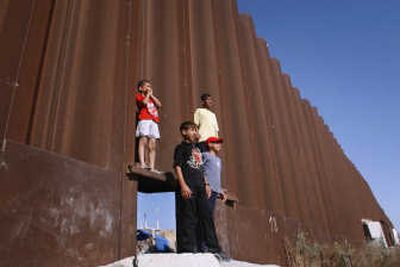
WASHINGTON – As they try to work out a joint approach to a Gaza Strip controlled by the militant group Hamas, the United States and Egypt are parting ways on the key issue of how to control the Palestinian territory’s dangerous southwestern border.
U.S. officials are urging Egypt to step up its efforts to halt the illegal flow of militants, arms and cash through Gaza’s border with Egypt, warning that Gaza could become a lawless haven for militants affiliated with such groups as al-Qaida and Hezbollah.
Egypt, however, insists the threat is greatly exaggerated, and dismisses American worries that Gaza could ever become a terrorist magnet, as Afghanistan was under Taliban rule.
“The truth of the matter is that the problem is not nearly as large as the (U.S.) allegations imply, and we’re doing quite a bit already,” Nabil Fahmy, Egypt’s ambassador to the United States, said in an interview.
Worries about the infiltration of militants, Fahmy said, were “nonsense” because border checkpoints were carefully manned, and the illegal tunnels that lace the border area are not large enough to accommodate a sizable flow of militants.
The border control issue has long been sensitive. For years, Israel has charged that Egypt has not done enough to halt the flow of smuggling that has been helping to finance and arm Hamas. Now, however, the issue has gained new importance, as Israel, the United States and European allies try to isolate Hamas and build up the more moderate Palestinian Authority President Mahmoud Abbas, whose rump government controls the West Bank.
Egyptian President Hosni Mubarak is the host of a meeting in Cairo on Monday for the Israeli, Jordanian, Egyptian and Palestinian Authority officials to discuss how they will deal with the new order that emerged last week when Hamas ousted Fatah from Gaza.
American and Israeli officials agree that Egypt has been stepping up its efforts in recent days to halt the traffic. A senior administration official said that the Egyptians “are making more of an effort, and do perceive a definitely increased risk” at the border since the ouster of the Fatah forces.
Regardless, the official said, Egypt “needs to do more.” David Welch, the assistant secretary of state for the Middle East, will raise the issue again with Egyptian officials in the next few days.
Meanwhile, in a further sign of American concern, the House early Friday adopted a foreign aid bill that would cut $200 million of the $1.3 billion in annual military aid to Egypt unless it halts smuggling at the border and curbs human rights abuses.
A top U.S. worry is that the 140-square-mile area of Gaza could provide Iran an even more important foothold in the region. U.S. officials have long charged that Iran is providing arms and cash for Hamas, and offering military training outside of Gaza for members of the Palestinian Islamist group.
Egyptian officials insist that most of the smuggling is via the Mediterranean, which is patrolled by the Israelis. They contend that searching out the dozens of smuggling tunnels is an overwhelming job, especially since they are limited to fewer than 1,000 police and soldiers under an international agreement to demilitarize the area.
Ambassador Fahmy took strong exception to the House foreign aid bill.
“It’s shortsighted and leaves a very bad reflection on how America treats its friends – very few of whom actually remain,” Fahmy said.