
In search of a little down time

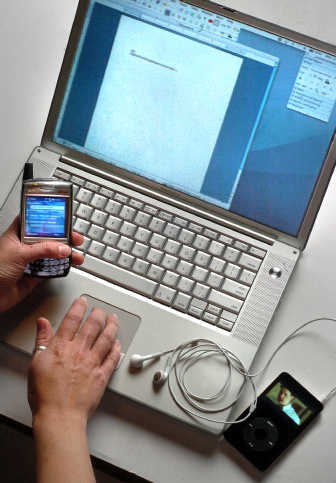
Before each class, Mark Fuller, a Washington State University information professor, routinely requires students to turn off any devices they might use to text-message others during his lectures.
Bill Kalivas, a Spokane technology executive who sells security systems to major corporations, now allows himself to use e-mail and a cell phone at home only when his two children are asleep.
David Levy, a University of Washington professor and researcher on information overload, now schedules a weekly 24-hour Sabbath from electronic devices. All three say they’re coping with the crisis of too much information flowing at us from too many sources.
Levy, who has lectured on the topic and plans to write a book on how electronic communication has affected people, said the problem is part of an ongoing “more-faster-better” syndrome afflicting modern life.
“This really isn’t something altogether new,” said Levy. “But there is a radical intensification of the problem due to the vast expansion of the communication environment around us.”
At the most basic level, the explosion of devices and connectivity has eliminated the old barrier between work and private life, he said. That means many of us have become addicted to having a cell phone, iPod and laptop with us as key tools in how we deal with our co-workers and families.
On a more global scale, Levy worries society has reached a crisis that places people right at or very near the biological and psychological limits for how much information any one person can manage.
That’s creating a broad search for better ways of managing our lives, he added, noting that “we already know that we don’t need to be online 24/7.”
Levy and others are learning that it’s hard to preach the gospel of balancing work and life in a digital age. For Levy, the issue is at a stage akin to the environmental movement in the late 1970s. People then knew the environment was important, but it took another 20 years before countries and governments began tackling the problem, he said.
The same thing will happen, he said, as people address the information onslaught. “We now need to start looking for ways to mitigate the worst effects” of too much information, said Levy, a professor at the UW’s Information School.
In his own life, Levy now follows a strict Jewish Sabbath. From sundown Friday to sundown Saturday, he turns off his phone and his computer. “I feel much better without them,” he said.
Kalivas and Fuller both acknowledge that the online life is a powerful drug.
“In the technology industry, you get so caught up,” said Kalivas, the father of two young children. “You get sucked into this feeling you have to keep up with the pace of information and the pace of business. Or your competitor will get ahead of you.”
When he was most afflicted with what he calls “over-connected syndrome,” Kalivas would get up at 3 or 4 a.m. and go to his computer to check e-mail, making sure he knew what was going on with his colleagues and business contacts.
Today he’s promised his wife to limit his work calls and e-mail to late night and early morning. He tries to focus on a “regular” schedule, with family time reserved for home activities and getaways.
Fuller, who has been a WSU administrator for five years, is also learning how to adjust his life and control the beat of electronic messages coming at him from students, colleagues and others.
He took his family on a trip recently to Nebraska, stopping at a Yellowstone Park hotel for three days. It had no phones, no Internet and no cell phone service.
It was hard for the first two days to remain detached from electronic devices, said Fuller. “We’re so conditioned to being in constant communication that it’s very odd not to be connected,” he said.
He’s developing strategies to hold back the flow. When he needs to get a task done at the office, he shuts down his e-mail and turns off the smart phone he carries.