
An acre of iris
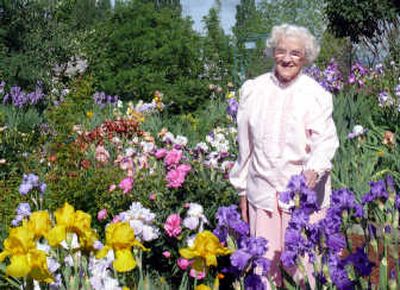
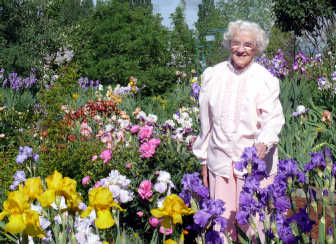
Mildred Beitzel has been growing irises since 1954.
At one point, during her 50 years living in Palouse, Wash., Beitzel had more than 850 varieties. Now in Spangle, she still has hundreds of iris varieties. Her high regard for the plant was influenced by her father and continued with her daughter, Marilyn.
“Oh, my daddy had irises in Kansas, and I have some of them here still,” said Beitzel.
“My dad was growing irises when I was in high school. He had 500 varieties, and people would come from Missouri and Nebraska and Oklahoma to see them. There weren’t a lot of people growing irises at that time. So that’s where I got my love for the iris.”
A profusion of irises, peonies, roses, lilies and herbs cover about one acre of the seven-acre property. Beitzel has divided the garden into theme sections. There’s the Fun Corner, where all the irises have funny names such as Doodle Strudel, Boom Boom Blonde and Bewilderbeast. The heavens have descended into the Angel garden, with Purgatory, Avenging Angel and Angel’s Blush. There’s the Family Circle, with iris names of all the family members.
“Then I have an herb and tea iris garden, where the irises all have ‘tea’ in their names,” said Beitzel. “There’s Spot of Tea, Tea Apron, and Teapot Tempest. We have mint, chives, sage, thyme and horehound. I make horehound candy.”
Many iris varieties can be grown in the Northwest. One of the most common is the tall bearded, although there are also border, intermediate, standard and miniature dwarf bearded.
Siberians and Japanese irises are beardless, the latter having huge blooms. Spurias are tall, and Pacific Coast Natives grow best where their name suggests, in the coastal areas of the west. There are more than 30,000 iris varieties. Each must have a registered name. Some are scented, such as Orange Popsicle and Southland Grape.
To be considered antique, an iris must be at least 30 years old. Beitzel has plenty that fulfill this requirement in her Over the Hill Gang, which includes many from the 1700s. She claims the old-timers are especially vigorous. Older irises are often simpler, flat, without ruffles, lace or spoons. Modern irises come in a huge selection of shapes, colors and sizes.
“This is something they’re doing now; they call them Space Age,” says Beitzel, pointing to an especially exotic bloom. “They have hooks instead of just the beards. Some of them have a spoon or a ruffle.”
Beitzel also grows some rare irises, such as Curious Yellow, a huge burst of golden color, and Florentine Orris, her oldest, first recorded in 1500 in Italy. Irises that are no longer in circulation are considered rare, as are the new irises, which can sell up to $50 a rhizome.
A rhizome is the horizontal stem of a plant that often sends out roots and shoots from its nodes. When her husband was healthier, they used to sell rhizomes from their garage, neatly stacked in alphabetical order.
“What we did here, people would see our irises in May and June, and they’d order what they wanted and then we’d dig these in July,” said Beitzel. “You plant the rhizome like a duck in the water. The top needs to be near the surface to get water, with a little bit showing.”
In the Northwest, irises generally blossom from April into July, although rebloomers – ones that bloom twice – can last into November if watered regularly. The average blossom lasts two to three weeks. Irises can range anywhere from six inches to four feet in height. Small irises bloom first, then intermediate, then tall, and within each type there are discrepancies, so the garden can burst with color for many months.
Beitzel declares all her irises are her favorites, although she does have a special fondness for lacey edges and for Rancho Rose, a beautiful pink German bearded bloom. She says there are many avid iris growers in this area, and all have their own preferences. Luckily there are enough varieties in the iris family to please almost everyone.
“I enjoyed it when people came to see our irises down in Palouse, where we lived for half a century,” said Beitzel. “This one woman didn’t want anything with red. Another didn’t want any with blue. Some want the pastels, and some want the vivid colors
“It’s fun.”