
TIES THAT BOND
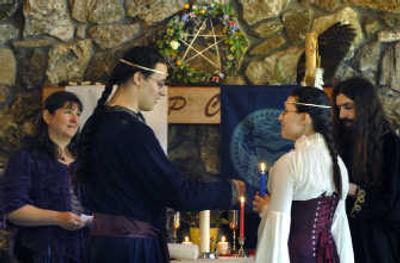
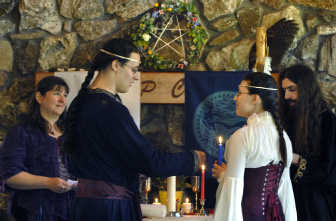
Standing before the altar, the couple clasped hands – binding them together as a symbol of their love.
“You are bound by the forces of spirit, the blessings of the elements and the sacred powers,” said the priest, tying their hands together with a hand-woven cord. “Love, protect and cherish each other.”
To celebrate their new life together, Jaspenelle and Michael Stewart had a handfasting last week.
An ancient marriage ritual that predates Christianity, handfasting is the “spiritual joining of souls,” a sacred rite usually observed by pagans and others who worship nature and observe the cycles of the Earth. For the ancient Celts, handfasting was a way to finalize a couple’s intention to marry in exactly one year and a day.
Handfasting, which was practiced for centuries in the British Isles, is also the origin of the expression, “tying the knot.”
Last Saturday – on the summer solstice, more than two years after they were legally wed in December 2004 – the Spokane couple invited loved ones to their spiritual wedding.
“This is our commitment to each other and to building a family,” explained Jaspenelle Stewart, an artist. “It’s about how the two of us will work together in order to accomplish our goals. … It’s a celebration of our love.”
In other words, it’s a wedding in every sense of the word – only without the frothy white gown, the assembly of bridesmaids, the limo, confetti and other extras that are commonly seen when two people wed.
Months before the wedding, the couple spent many hours writing and planning the ritual – from the summoning of the elements and the lighting of the unity candle to the binding of the cord and the jumping of the broom.
On the morning of their handfasting at Spokane Valley’s Dishman Hills Natural Area, bride and groom and their ritual bearers spent the early hours in preparation for the big event: They blessed the food they would later eat, cleansed the ceremonial space by burning incense and spreading sacred salt, and cast a circle with votive candles surrounding the altar.
While unusual in scope compared to most nuptials in Spokane, the atmosphere at the Stewarts’ handfasting was perhaps no different than any other wedding: People cried when the couple read their vows out loud and they laughed when the priestess made a joke. There was fellowship, anticipation, anxiety, great joy. And the bride and groom, sometimes on the verge of tears, smiled and gazed at each other with love.
Sharing their faith
Michael, 24, and Jaspenelle Stewart, 21, met online in April 2003, after being introduced by a mutual friend. Both had come from conservative Christian backgrounds but later found themselves increasingly drawn to paganism, a spiritual path that emphasizes the awareness of nature and the indigenous practices of ancient peoples.
They became close friends but didn’t meet each other in person until September 2004. Jaspenelle, a Canadian who was living in Spain at the time, eventually decided to move to Spokane to be with Michael. Three months later, they were legally married at the Hitching Post in Coeur d’Alene.
Last weekend, they finalized their union with the handfasting ceremony surrounded by family and friends – Christians, Jews, Buddhists, pagans and others. Since few of the guests had ever attended such an event, the Stewarts prepared a Web site with information on handfasting and their pagan beliefs.
“For us, the Gods and Goddesses provide us with wisdom and knowledge to guide us through our lives; they are an inspiration to us,” wrote the Stewarts, who belong to a local group of pagans and spiritual seekers.
“That said, the handfasting is a magical and spiritual rite. … Why are we telling you this? Because we don’t want any of you to be surprised when you show up for our handfasting expecting a white wedding. We are telling you this in the hope that everyone who attends will do so with an open mind no matter what your beliefs are. We believe in tolerance above all, and the right for everyone to follow their own beliefs, whatever they may be.”
A colorful occasion
Adhering to the handfasting’s Renaissance theme, the ritual bearers and a few guests wore long, flowing robes in ebony, deep purple and other warm colors. Most who came, however, showed up in suits and ties or colorful summer dresses suitable for any formal occasion.
After rehearsing their lines and preparing the wood cabin for the ceremony, the couple stood barefoot in the center of a circle, before an altar with candles, a chalice and other symbolic items. A wreath – a pentacle adorned with flowers – was placed prominently above the stone fireplace.
Like the candles and other decorations, the garments worn by the couple were designed by the bride herself.
She wore an ivory peasant blouse with loose, lacey sleeves underneath a burgundy corsette. The groom donned a violet tunic accompanied by a sash at the waist that matched the bride’s dress. The couple both braided their long dark hair and wore matching bands on their heads, custom-made by a silversmith in Oman.
After the chime of a bell, each of the four attendants in the circle took turns summoning the elements of earth, air, fire and water.
“Vivacious waters, tranquil waters, every changing life blood of the planet!” invoked Peter Geyer, an ordained minister and the priest at the ceremony. “Come cleanse, charge, consecrate this sacred union … Bless them with ever-flowing love, hope and devotion.”
The ceremony lasted less than 15 minutes. But in that brief moment, before the exchange of vows and the lighting of the unity candle, the couple not only paid homage to the earth, but also to their parents.
“You have made me who I am today,” Michael told his mom and dad, Greg and Kim Stewart of Spokane, as he presented them with necklaces that he and Jaspenelle made by carving a heart and the trinity knot into beads made of applewood. “You have taught me to love nature and all of life …”
“You have both given me the gifts of love and understanding that are the foundation of who I am, and I am grateful,” Jaspenelle told her parents, Loretta Polman, of Spain, and Nathan Polman, who lives in the United Arab Emirates.
After exchanging vows, which they wrote on scrolls of paper, the priest tied a cord around Michael’s right hand and Jaspenelle’s left. “Go now and cross the gateway into your new life and celebrate your love,” he said. “May the circle be open but never broken.”
The couple then jumped over a broom.
‘We feel like newlyweds again’
At the reception, guests were abuzz with excitement. Never before had they taken part in a handfasting, they said. And while unusual, it was deemed by many to be a memorable and profound moment.
“We were trying to bring good energy to support them,” said Jessalynn Grant, one of the ritual bearers. “It’s a marriage ceremony, but just a different style.”
Greg Stewart, Michael’s father, said he was deeply moved by the handfasting. “We’re Mormons, so it’s different for us,” he said. “But I found it to be a peaceful, uplifting ceremony. It was very touching.”
For the couple, the day marked a new beginning. As they stood in the circle that Saturday morning, a sense of peace and gratitude – almost like meditation – washed over them, they recalled.
“We feel like newlyweds again,” said Michael Stewart, describing the heightened energy in their relationship. “Before, we were together legally. Now, we’re together spiritually and forever.”
Reach staff writer Virginia de Leon at (509) 459-5312 or virginiad@spokesman.com