
Epic proportions
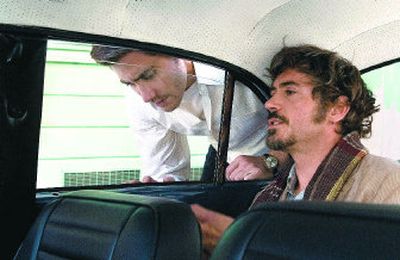
Director David Fincher knows some people may think his serial-killer saga “Zodiac” is too long at 2 hours, 40 minutes.
He’s wondered the same thing himself, but decided the film needed that much space to tell the story he wanted.
“Zodiac” and other recent epic-length films such as “The Good Shepherd” reflect an age-old Hollywood balancing act: satisfying filmmakers’ artistic desires without causing audiences to squirm in their seats.
“I would have loved the movie to have been shorter. I just couldn’t find a way to dramatically do that,” says Fincher, whose previous films include “Fight Club” and “Seven.”
“Sometimes, maybe filmmakers can fall in love with the story they’re telling and maybe need to be more diligent in how they’re telling it,” he says. “In our case, you’re talking about an investigation that took 35 years, and we just felt like there was no way to actually do what we wanted in any less time.”
Opening today, the film stars Jake Gyllenhaal, Robert Downey Jr. and Mark Ruffalo in the convoluted, decades-long journey of police and newspaper reporters to crack the case of the “Zodiac Killer,” who terrorized the San Francisco area in the 1970s.
Long, long movies have been around since Hollywood moved beyond one-reel shorts in the early silent-film days. D.W. Griffith’s historical epics “Intolerance” and “Birth of a Nation” ran three hours, and Cecil B. DeMille approached that length with his biblical pageant “King of Kings.”
Few fans would gripe that three-hour masterpieces such as “The Best Years of Our Lives,” “Schindler’s List” or the first two chapters of “The Godfather” are too long.
And cinema buffs reveled in the 1989 reconstruction of “Lawrence of Arabia,” overseen by Steven Spielberg, which restored David Lean’s epic close to its original length of 3 hours, 40 minutes.
” ‘The Godfather’ merits all that time and more,” says critic Richard Roeper, of the Chicago Sun-Times and TV’s “Ebert and Roeper and the Movies.”
“But 80 to 90 percent of the films I see could benefit from 10 to 15 minutes in cuts,” he says.
Woody Allen’s films generally come in well under 2 hours and often closer to 90 minutes. Stephen Frears similarly delivers tight films with little fat, including his rich portrait of British monarch Elizabeth II in “The Queen,” for which Helen Mirren won the best-actress Academy Award. The film clocks in at a brisk 103 minutes.
“I do think that most films are too long,” says Frears. “I’ve seen too many long films. I’ve learned to be sympathetic to the audience.”
Some critics thought Martin Scorsese’s “Gangs of New York” or Robert De Niro’s “The Good Shepherd” – both clocking in at about 2 hours, 40 minutes – would have been greatly improved at closer to two hours.
But who’s going to tell Scorsese or De Niro to chop 30 minutes?
Five of the 10 best-picture Academy Awards nominees the past two years have run around two and a half to three hours, among them the newest Oscar champ, Scorsese’s “The Departed.”
Hollywood’s prestige films have typically tended toward epic productions, from “Gone With the Wind” and “Ben-Hur” to “Gandhi” and “Titanic.”
Lately, studios have been emboldened by such blockbuster successes as “The Lord of the Rings” trilogy, “The Chronicles of Narnia: The Lion, the Witch and the Wardrobe” and the “Harry Potter” films.
Recent thrillers and action flicks that far exceeded 2 hours include “Casino Royale,” “Apocalypto,” “Miami Vice,” “Superman Returns,” “The Da Vinci Code” and last year’s box-office king, “Pirates of the Caribbean: Dead Man’s Chest.”
General Hollywood wisdom is that it’s bad business to let a movie run on at the mouth because it limits the number of screenings that theaters can fit in each day, potentially undermining a film’s profits.
Peter Jackson’s mammoth remake of “King Kong” did big business, but nowhere near the totals of his “Lord of the Rings” movies. Some critics said audiences were disinclined to spend more than 3 hours watching a giant ape.
With $1 billion worldwide at the box office, “Dead Man’s Chest” clearly was not hurt by its 2 hour 30 minute length. Nor was distributor Disney put off by the running time, says Jerry Bruckheimer, who produces the “Pirates” movies.
“They loved the film. They always would like things shorter to get more screenings in in a day, but they also recognized we made a very effective movie that held people’s interest,” Bruckheimer says. “When you walk out of that theater, you want to feel like you’ve had a complete meal.”
David Yates, director of this summer’s “Harry Potter and the Order of the Phoenix,” says some of today’s big popcorn flicks overwhelm audiences, throwing one too many action sequences or visual-effects shots up on the screen.
“Sometimes they overstay their welcome just by that little, tiny percent,” Yates says. “There’s a sweet spot for running length where the audience comes out feeling elated, feeling they actually want more. Reaching that sweet spot takes a lot of discipline.
“You just have to let things go, sometimes. It’s amazing how you think you could never live without a scene or a moment, yet frankly, the movie’s better off without it.”
Fincher let plenty of moments go on “Zodiac,” which ran 3 hours and 8 minutes in an early version. Yet there were many more he felt the film could not live without.
Initial talks with Sony about backing the film fell through because the studio wanted to limit it to 3 hours and 15 minutes, Fincher says. Paramount and Warner Bros. came on board and agreed to give him more breathing room on length.
“I do agree you can’t just make movies 3 hours long for no apparent reason. For a romantic comedy to be three hours long, that’s longer than most marriages,” Fincher says.
For a movie such as “Zodiac,” which is more about the killer’s psychological victims than his physical victims, “there’s stuff in the narrative that’s not essential to the investigation, but if you start removing that stuff, it becomes even more of a dry police procedural,” he says.
“You need to have that characterization in there but not wear out its welcome. It’s not my intention to be boring. The hope is you’re able to walk a fine line.”