
Carried Away
It’s no secret that babies spend about nine months inside the womb before making their big entrance into the world. But the next nine months are an equally important gestational period, one in which infants need to be held and carried almost as if they were still in the womb. Anybody who has set down a content baby only to watch her erupt into a red-faced squall has seen this theory in action.
For centuries, parents around the world have toted their young ones in slings and wraps while they went about their daily business. And now, a new generation of parents is discovering the old concept of “babywearing” as a way to soothe their babies while keeping their hands free to attend to older kids, do housework or run errands. The latest carriers even come in cocktail-party-worthy fabrics and patterns, complete with matching bags in which to carry the carrier.”It’s like being in the womb for a few more months,” says Margaret Hildahl, owner of Mother’s Haven in Coeur d’Alene, which sells a variety of slings and carriers. “We need to hold our babies more. Our nation is so into self-pacifying and all that stuff … Babies get so upset in the early months. They just want to be held a lot.”
MacKenzieMonroe, a Spokane mother, knows how true that is.
Monroe started wearing her son in a sling when he was just 3 days old.
“When nothing else will calm him down, that will,” says Monroe, whose son is now 10 months old. “Still, when he’s having a rough night and won’t go down, my husband says, ‘Where’s the carrier? Where’s the carrier?’ “
Monroe is a member of a new group, the Spokane Babywearers, which formed several months ago to help parents find the right carrier and learn how to use them properly.
Stacey Goranson, a mother of two from Liberty Lake who makes and sells baby slings, started the group to help raise awareness of babywearing.
“It’s really just a bunch of moms getting together that all have the same issues,” Goranson says. “It ends up, people are talking about cloth-diapering, pediatricians …”
Goranson started Babymoon Slings (www.babymoonslings.com) about six years ago, shortly after the birth of her first child. She sells almost all of her slings online. Although each one comes with detailed instructions, she found many new parents still had trouble figuring out how to use them.
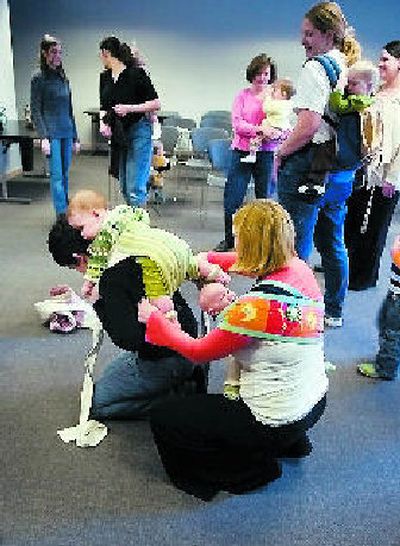
During a recent meeting of the Spokane Babywearers at the South Hill Library, about a dozen moms filed in, some with babies strapped to their backs, others with infants nuzzled on their chests, some holding the hands of their older children at the same time.
They showed off the wide variety of carriers available, swapping between each other and teaching other moms how to use each one.
Carriers range from old-school and basic to more complicated gadgets with straps, snaps or buckles. On the more-primitve end, there’s a long, unadorned swath of fabric known as a SPOC (a Simple Piece of Cloth). The fabric can be wrapped origami-style around baby and parent in a variety of positions, both front and back. The wraps are made out of either stretchy or woven material. One such brand is the EllaRoo Wrap, which retails for about $70 to $80.
Then there are slings with metal rings that can be adjusted to fit snugly around the baby. Some of these slings are padded, others are not. (Goranson’s Babymoon Slings are of this variety and sell for about $45.) There are also pouch slings, in which the fabric is sewn into a small pocket for baby to nestle in.
An increasingly popular type of carrier in this country is the mei tai, a Chinese invention. Mei tais are square-shaped pieces of fabric with straps on all four corners. The baby (and even a heavier toddler) can be worn on the back or front, depending on how the straps are tied. As with some of the other carriers, mei tais (which sell for about $70) can be ordered in fabrics to match nearly every outfit or personal style from floral to polka dots to golden brocades. You can buy accessories for the mei tai, including a soft, fuzzy liner and coordinating carrying bag.
There are carriers to tote a child on your hip (often used for heavier or older kids) and there are soft, backpack-style carriers (such as the ERGO Baby Carrier, $92) with shoulder straps and a waist belt.
Many babywearing fans include several types of slings in their arsenal for different situations.
Sara Birnbaum has about half a dozen wraps and carriers that she has used with 11-month-old Henry.
“I’ve had my son in a sling since he was two weeks old,” says Birnbaum, of Spokane.
Henry suffered from reflux and liked to be held upright most all of the time.
She started with a ring sling, but once Henry started getting heavier, she looked at other options. She now has a mei tai, as well as a wrap and a pouch sling.
“It was a real life-saver,” Birnbaum says. “It was so hard those first few weeks. Having him in the sling helped so much. It calmed him down.”
And now, she says, her son “is like a world explorer.”
“I think him being close and supported and the whole sort of global feeling he got from being close to me, I think that helped a lot,” she says.
Babywearing is popular among moms and dads who adhere to the theory of “attachment parenting,” a practice that emphasizes co-sleeping, extended breastfeeding and other bonding activities that are believed to help foster emotionally healthy kids.
But you don’t have to buy into the entire attachment-parenting style to benefit from babywearing, some say.
“For me, it was just convenience,” Goranson says. “It’s so much easier to attach the baby and go. It’s easier than a stroller or car-seat carrier … There’s a misconception that it’s a really granola thing to do.”