
Worsening traffic crunch assails Wenatchee
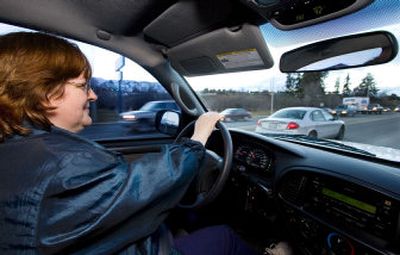
WENATCHEE – The clock on the dashboard says 5 p.m., and the car’s at a standstill in the snarl of daily commuters trying to get out of Wenatchee and home for dinner. The time it takes to drive between jobs in the city and homes in outlying areas during the morning and afternoon commutes is getting longer and longer.
So what’s being done to ease this congestion?
With little money and no space to expand city streets or build new ones, local officials warn there’s not much they can do.
And as the Wenatchee Valley grows, it’s only going to get worse.
“I’m sorry to say it, but the silver bullet is not on the way,” said Jeff Wilkens, executive director of the Wenatchee Valley Transportation Council.
Based on expected growth, the agency is predicting severe congestion on Wenatchee’s main streets by 2010 and bumper-to-bumper gridlock by 2025.
Two major road improvement projects set to begin in the next few years – Sunset Highway and the Sen. George Sellar Bridge – are not fully funded. And they are not expected to ease congestion through the Wenatchee Valley for very long.
Nothing is currently in the works to ease traffic jams at other hotspots, including North Wenatchee Avenue, downtown Wenatchee, Mission and Miller streets, Chelan Avenue and the railroad crossings near the riverfront.
“There’s no magic pill, no wand we can wave to fix the problems,” said Chelan County Commissioner Buell Hawkins. “There’s really nothing that’s available to us in the short term to effectively eliminate the congestion problems we have around the Wenatchee area.”
Because of the geographic constraints of the Columbia River, Wenatchee River and western foothills, there is no room to add more streets or widen roads to accommodate more traffic, local officials say.
The most promising long-term solution to gridlock is building a third bridge across the Columbia River, Wilkens said.
But finding the estimated $150 million to $200 million to build it could be tough.
“I don’t think we can build our way out of this problem with more or bigger roads,” he said. “Instead, we need to be looking at our lifestyles and finding ways to cut down on the amount of driving we do.”
Wenatchee attorney Scott Volyn has altered his morning routine, driving from his home in Sunnyslope to his office in the Morris Building downtown a little earlier to avoid the morning rush hour.
But he can’t avoid the afternoon rush hour, which hits between 4:30 and 5:30 p.m. each weekday. He knows the wait at traffic lights is getting a little longer, and it takes a few more minutes to get home.
But after living in Portland for a time, Volyn said people in Wenatchee have no idea what real traffic problems are like.
“We have become accustomed to driving straight to our destinations with little delay,” he said. “When we see a line of 10 or 12 cars in front of us, we get upset. As the city grows, though, you’re only going to see more and more of that.”
Volyn said that choosing to live in Sunnyslope means choosing to live with the increasing traffic congestion on North Wenatchee Avenue.
“What’s the alternative? Am I going to move to Entiat to live and work?” he asked. “Not if I want to be near my customer base.”
Wilkens said North Wenatchee Avenue is the valley’s biggest traffic problem without a solution in the works.
Local officials have floated several ideas for easing traffic flow or diverting traffic to other north-south streets.
“But there are enormous price tags to things like that,” Wilkens said. “I don’t know if the community would support the cost or the impacts of taking out entire neighborhoods.”
The traffic problems are exacerbated by topography. With two rivers bisecting the valley, nearly every idea requires building a new bridge across at least one of them. The hills to the west of Wenatchee and east of East Wenatchee also restrict where new roads can be built.
“If this was Lincoln, Nebraska, we wouldn’t be having this conversation,” Wilkens said. “We’d simply build out in the flat areas around the city.”
Wenatchee’s traffic problems are indicative of a way of life its residents have enjoyed for years, Wilkens said. People like to drive – to work, to the store, to get a cup of coffee.
Many parents choose to drive their kids to and from school each day, creating short-term pockets of congestion around all the elementary, middle and high schools every morning and afternoon.
Most people live in single-family homes that fan out from the commercial centers into the suburbs, the surrounding hills, and increasingly into outlying areas like Sunnyslope.
“Our traffic problems are the result of choices that people have already made,” Wilkens said.
Sunnyslope has been identified by city officials as an area that will accommodate much of the city’s population growth in the next 20 years, possibly tripling the number of people living there.
Meanwhile, East Wenatchee and surrounding areas of Douglas County are growing as water and sewer services are extended.
Now, local officials are considering extending domestic water up the Wenatchee Valley to Monitor, and possibly farther one day. That could accommodate more residential growth in those areas. Douglas County agencies are also attempting to run water and sewer out to Pangborn Memorial Airport, with the potential to serve 1,000 homes in the area.
Yet the majority of jobs in the area remain in Wenatchee, requiring people to commute through north Wenatchee or across the Columbia River bridges to reach work, Wilkens said.
“If you continue to grow out into areas like Sunnyslope, Entiat, the Upper Valley, Orondo, Rock Island, and the canyons and the foothills around Wenatchee, the only way to get around is by car,” he said. “All you’re going to do is make more traffic congestion coming into the metropolitan area where the majority of people work and shop.”
“There’s no way to build enough roads and highways to handle that kind of growth in this valley,” he said.
With few options for easing traffic congestion with new roads and bridges, local officials say the Wenatchee Valley will have to be creative in looking for gridlock solutions.
Public transportation is a primary option, Wilkens said, along with city design.
The city of Wenatchee’s riverfront and downtown comprehensive plans call for more urban-style, multifamily living close to commercial areas.
Similarly, a plan for the Sunnyslope area includes clustering multifamily housing around a small commercial village.
“One of the most important ways to address traffic congestion is making it easier for people not to drive,” Wilkens said.
Local officials say having fewer cars on the road – and not building more roads – is the only long-term solution to traffic woes in the valley.
“Realistically, the best case scenario is that traffic congestion will get no worse than it is today,” Wilkens said. “But it’s not likely to get any better from here on out.”