
Playing safe
Little League elbow. Jumper’s knee. Shin splints. Heel pain. Back pain. Shoulder pain.
Ouch.
Those are some of the overuse ailments seen by doctors working with young athletes. Anybody can suffer a repetitive-stress injury, of course, but growing bodies are particularly sensitive to them since their bones often outpace their muscles in growth.
“Kids can grow a quarter of an inch in a week,” says Dr. P.Z. Pearce, a Spokane sports-medicine expert.
And doctors are seeing more and more kids with these types of overuse problems, Pearce says.
“We’re seeing more, paralleling the increase in participation in sports,” he says. “Kids are becoming more competitive. They’re playing more sports. They’re playing on multiple teams.”
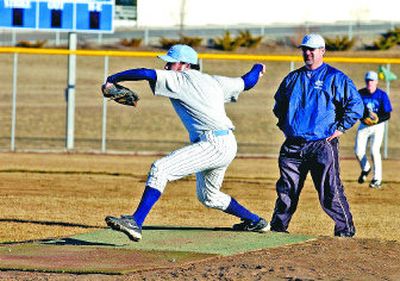
Baseball coach Jeff Simmelink oversees the Spokane Dodgers, an elite traveling team of young ballplayers. His players are some of the area’s best, and many are aspiring to careers in baseball in college and, in some case, the major leagues. Pitching is a prime cause of overuse injuries because it places so much stress on the arm. Preventing overuse injuries in pitchers is one of his top priorities, says Simmelink, who himself suffered a career-ending shoulder injury after being drafted by the Cleveland Indians in the 1980s.
“It’s a huge issue,” says Simmelink, who also works with Central Valley High School baseball players. “Obviously, this is a career that these young men desire. You have to develop them and do the things that allow them to achieve their goals.”
To do that, he keeps a close eye on pitch counts.
“It all depends on the time of year,” he says. “You build up your pitch count. In the winter, we really just play catch and work on mechanics.”
At the height of a summer season, a player will generally throw no more than 85 pitches per game, he says.
“You make sure they have adequate rest,” he says. “The day after you pitch, we set you down. Our pitchers have learned to live with that.”
He also makes sure his players are properly conditioned, with both cardiovascular and strength training.
“Scary.” That’s how Jeff Purser of Mead describes the experience of watching his then-16-year-old son, Mark Purser, rupture a tendon in his arm while pitching a high school game.
Jeff Purser doesn’t completely blame the injury on overuse, though he says that was a contributing factor.
Mark Purser ended up having ulnar collateral ligament reconstruction, commonly known as Tommy John surgery. He had to take a year off from pitching but expects to be back up at full speed this year, his senior year.
“There is no kid that I’ve ever met that wants to win more than my son,” Jeff Purser says. “The way he plays, he plays all out. He doesn’t care about his body.”
Even after the surgery, he continues to throw pitches upward of 90 miles per hour. Mark Purser still gets scouted by major-league teams, his dad says. He has decided to go to Spokane Falls Community College next year, to study firefighting, before transferring to a Division 1 school.
But, his dad says, “He definitely wants to be drafted. That’s his goal.”
In this age of concern over childhood obesity, no one wants to discourage kids from being active. But some experts would prefer young athletes take part in a variety of activities rather than specializing in just one sport.
“When children were mainly engaged in free play, we certainly saw a lot of broken bones. But there were at least not reported to be so many of these overuse injuries,” says Dr. Angela Smith, an orthopedic surgeon with the Children’s Hospital of Philadelphia and past president of the American College of Sports Medicine. “Now, a child is more likely to be playing soccer several times a week, and maybe doing that sport year-round and playing for many teams.”
Care should especially be taken during a child’s growth spurts, Smith says, since that’s when the body is most vulnerable to injury.
“Those are times to back off of activity,” she says.
Mark Whitley, a Spokane physical therapist, works with high school athletes to prevent injuries. He emphasizes core strengthening exercises, which help stabilize the knee and the hip. He also leads young athletes through “dynamic stretching.”
Unlike traditional stretches, dynamic stretches call on athletes to move while working on the muscles.
“It’s movement, basically,” Whitley says. “Having them skip with high knees. Run forward and backward. You’re trying to activate those muscles.”
Dr. Roger Dunteman, an orthopedic surgeon in Coeur d’Alene, says parents should pay attention when their child athlete complains of aches and pains, especially when it’s preceded by an increase in activity.
Most of the overuse injuries he encounters get better with rest, Dunteman says.
It’s difficult for the child to take a break, he says.
“But that’s where the physician can get involved,” he says.
Joe Seaman has encouraged his son Andrew, a pitcher for Coeur d’Alene High School and the Spokane Dodgers, to speak up when he needs a rest. Andrew Seaman, a high school senior, has accepted a pitching scholarship at West Point.
But it’s tough to tell the coach you can’t continue.
“He feels like he’s letting his team down, letting his coach down,” Joe Seaman says. “Of course, you want to see your kid out there pitching in the seventh inning and winning the ballgame. … At the end of the day, it’s about continuing a career in baseball and not today’s game.”