
Court hears free-speech case
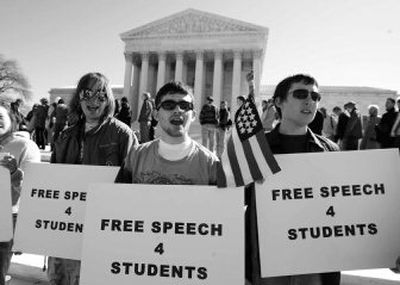

WASHINGTON – High school students may have a right to free speech, but that does not include the freedom to unfurl a banner promoting “bong hits” during a school activity, the Supreme Court was told Monday.
An unusual case from Alaska tests whether principals and teachers can punish students for banners, buttons or other messages that conflict with the goals and policies set by school officials.
During Monday’s argument, former U.S. Solicitor General Kenneth W. Starr and a Bush administration attorney urged the justices to defer to school officials when deciding what messages are appropriate on and around a high school campus.
“Illegal drugs and the glorification of the drug culture are profoundly serious problems for our nation,” said Starr, now the dean of the Pepperdine University Law School. He represents a school principal from Juneau, Alaska, who was sued for ripping away the banner and suspending the student who unfurled it.
Permitting the banner to be displayed would be “interpreted as an encouragement of the drug culture,” Starr said.
But a lawyer representing the student said the right to free speech should prevail so long as the message did not “disrupt” classrooms or the education process. “This is a case about free speech. It is not a case about drugs,” said Douglas Mertz, a lawyer from Juneau.
His client, Joseph Frederick, was an 18-year-old senior in 2002 when the torch for the Winter Olympics was scheduled to pass in front of the high school. Frederick was standing on a public street as the TV cameras came into range. He and several other students then unfurled the 14-foot banner that said, “Bong Hits 4 Jesus.”
The school’s principal, Deborah Morse, ripped it away from the students and sent Frederick to the office. She planned to suspend him for five days, but when he invoked Thomas Jefferson and the First Amendment, she doubled the suspension to 10 days.
Frederick sued, alleging Morse had violated his constitutional rights.
A federal judge rejected his claim, but the 9th U.S. Circuit Court of Appeals in San Francisco ruled for the student and said the principal could be forced to pay damages.
No damages have been set, and the school board urged the Supreme Court to overrule the 9th Circuit.
During Monday’s argument, most justices seemed to lean in favor of Morse, who no longer is a principal but still works in the school district. However, they sounded unsure where to draw a line between a student’s free-speech right and the authority of the principal. Several also said they worried about giving school officials unchecked power to control what students say.
“I find that a very, very disturbing argument,” Justice Samuel A. Alito Jr. told Deputy Solicitor General Edwin Kneedler. School officials could “suppress all sorts of political speech and speech expressing fundamental values of the students under the banner of getting rid of speech that’s inconsistent with the educational mission.”
The outcome might turn on a ruling from the Vietnam War era. In 1969, the Supreme Court upheld the right of high school students to wear black arm bands to protest the war. Young people do not “shed their constitutional rights to freedom of speech or expression at the schoolhouse gate,” the court said then. However, its opinion made clear that principals and teachers need not tolerate “disruptive” speech or protests.
But Chief Justice John G. Roberts Jr. said Monday that the student’s “bong hits” banner was disruptive. “Can’t the school decide that it’s part of its mission to try to prevent its students from engaging in drug use?” he asked.
A ruling in the case will be handed down later this spring.