
Nigeria tackles sex harassment by teachers

ILE IFE, Nigeria – When Nigeria’s education minister faced an audience of 1,000 schoolchildren, she expected to hear complaints of crowded classrooms and lack of equipment. Instead, girl after girl spoke up about being pressured for sex by teachers in exchange for better grades. One girl was just 11 years old.
“I was shocked,” said the minister, Obiageli Ezekwesili, who has several children herself. “I asked – was it that prevalent? And they all chorused ‘yes.’ “
For years, sexual harassment has been rampant in Nigeria’s universities. But until recently, very little was done about it. From interviews with officials and 12 female college students, a pattern emerges of women being held back and denied passing grades for rebuffing teachers’ advances, and of being advised by other teachers to give in quietly.
The problem has spread into schools, says Ezekwesili, and there are signs that the government is finally ready to intervene. Now that harassment is even featured in a song by a popular Nigerian musician, Eedris Abdulkareem, it is almost impossible to ignore.
“Mr. Lecturer, come get it on with me,” croons a young girl in the song. “I’m gonna rub your back and your potbelly, make you pass my paper.” With a deep chuckle, Abdulkareem replies, “Come into my office.”
Most victims are college students such as Chioma, a 22-year-old with a “B” average, who repeatedly failed political science after refusing her teacher’s explicit demands for sex. She said he was a pastor and old enough to be her grandfather.
“Now it has been two years and everyone else has graduated,” she said. She is desperate to finish her studies and begin working to help support her family, yet “my life is stopped,” she said.
Chioma and others asked that their surnames be withheld. All said they and several close friends had been harassed.
Stigma prevents many more from speaking out, says Oluyemisi Obilade, a professor who teaches adult education at Obafemi Awolowo University at Ile Ife in central Nigeria.
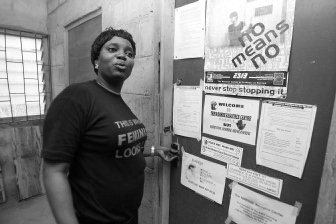
Like many Nigerian universities, the seemingly peaceful campus has witnessed horrifying sexual assaults. After a student was gang-raped nine years ago, Obilade formed WARSHE – Women Against Rape, Sexual Harassment and Exploitation.
Obilade estimates she has helped hundreds of female students – and the odd male – who have been attacked by students or harassed by lecturers. Students have been raped in libraries, reading rooms and their own dorms, she says.
“Some lecturers see young girls as fringe benefits,” she said, wearing a black T-shirt that says “this is what a feminist looks like.” “We’ve had cases where the girls have complained and the heads of their department have called them and said, ‘Give him what he wants.’ “
Mayowa, a 20-year-old student, said six of her friends are having problems and none has sought help. “It’s tough to fight,” she said. “Sometimes you just have to give in.”
In a recent survey carried out by a graduate student and funded by WARSHE, 80 percent of more than 300 women questioned at four universities said sexual harassment was their No. 1 concern.
But with a strong tradition of respecting one’s elders, families or teachers, harassed students can rarely expect support, even when repeated complaints are made against one individual.
Harassment is commonplace in schools and colleges in many African countries, says Miriam Jato, a senior adviser to UNFPA, the U.N. agency that deals with gender issues.
“In some rural areas, parents withdraw girls from schools when they reach a certain age because they are afraid they will have to have relations with teachers,” she said.
“It ruins their job prospects … or they get pregnant and they are kicked out of school as well …. The only possibility for her to get anywhere is for her to get married, and she can’t even do that if she is pregnant. So she may even be forced into prostitution.”
Yet attitudes are slowly changing. Ile Ife university recently fired a professor after repeated complaints. Chioma has found a woman lecturer to plead her case to school authorities.
WARSHE has extended its program to six other universities and a nearby secondary school, and Ezekwesili says she wants to set up complaints programs and join forces with women’s organizations.
“We are going to take punitive measures against these teachers and give a voice to students,” she said.