
Staying focused

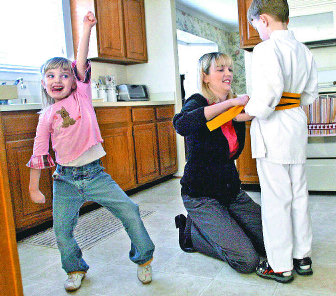
WASHINGTON – Cynthie Bush pulled on her coat and started to say goodbye. She and a friend were taking a night out for a quick dinner and a PTA event. It was not the kind of thing she did often, with two small children and a full-time job.
But before she could leave her suburban Washington, D.C., home, her 4-year-old daughter began to cry for her. For a moment, Bush recalled, she wondered if she should cancel. Her days were already so full. She needed more hours with her children, not fewer.
That whisper of worry and regret is familiar to a generation of mothers who juggle homework and housework, sports practice and dance lessons, in days that often include paid jobs and traffic-snarled commutes.
But for all the rush of modern life, recent research suggests that mothers are actually doing a better job than they may think, at least by historical standards.
According to a University of Maryland study, today’s mothers spend more hours focused on their children than their own mothers did 40 years ago, often imagined as the golden era of June Cleaver, television’s ever-cheerful, cookie-baking mom.
In 1965, mothers spent 10.2 hours a week tending primarily to their children – feeding them, reading with them or playing games, for example – according to the study’s analysis of detailed time diaries kept by thousands of Americans. That number dipped in the 1970s and 1980s, rose in the 1990s and now is higher than ever, at nearly 14.1 hours a week.
This is especially striking because it is at odds with how today’s mothers view their own lives: Roughly half of those interviewed said they did not have enough time with their children.
“It’s almost like it doesn’t matter how much they do, they feel they do not do enough,” said sociologist Suzanne M. Bianchi, the study’s lead author.
The research offers a look into a generation of great change for mothers. Fewer women lead the kind of life romanticized in the 1950s and 1960s – with a breadwinner father and homemaker mother. Yet while mothers’ hours of direct time with children have increased, so, too, have their expectations.
They have given up hours in other parts of their lives to make more time with their children – cutting back markedly on housework, which was down more than 40 percent over 38 years. They also trimmed their free time – and to some extent their sleep – as they increasingly multi-tasked. Multi-tasking hours roughly doubled.
“This is part of the burden of this generation of parents: enormously high expectations for how children develop, how they feel about themselves, how they achieve and how successful they are in the world,” said William Doherty, a family studies professor at the University of Minnesota.
Noteworthy for both its conclusions and comprehensiveness, the time diaries also show dramatic changes for fathers, who have nearly tripled the hours they spend focused primarily on their children. “They’re doing more but still dwarfed by what mothers are doing,” said co-author Melissa A. Milkie.
In all, the research, published in the fall, tells a complex story of family trade-offs and cultural shifts – over a span of years when U.S. mothers entered the workforce as never before and the number of families headed by single mothers jumped markedly. This was also a time when families had fewer children and parents were more educated.
“There is a greater stake in each child succeeding,” Milkie said.
Now, said Sharon Hays, of the University of Southern California, women – especially those in the middle and upper-middle class – feel that to be good mothers they need to be experts on child development and spend more and more time interacting with their children. Hays, who wrote a book on the subject, calls this “the culture of intensive mothering.”
But the world that families live in has changed, too. There has been an explosion of lessons and athletic teams for children as young as 3 years old. There are also more concerns about safety and crime, which affect how close parents stay to their children.
Not all time spent with children is the same, so the Maryland researchers looked at it in several ways.
There is primary time, when a child is the focus of a parent’s attention. There is secondary time – helping with homework, for example, while cooking dinner. Then there is a third category: just being with children.
Looking back to 1975 – the earliest year that diaries captured this level of detail – they found, again, that mothers gave more time than in the past.
For married mothers, hours with children rose from 47 a week in 1975 to 51 a week in 2000. For married fathers, the increase was greater: from 21 to 33 hours a week. Time spent by single mothers slipped from 50 hours a week to 44.
What the researchers could not capture was what they think of as “accessibility”: when a parent might be uninvolved but is around to be called on – inside the house, for example, when the children are in the back yard.
This may help explain why some mothers still feel their time with children is not enough, Doherty said. “You may get home from work at 4:30 and spend hours interacting with your child, but you may feel bad that you weren’t around all day.”
Sociologist Kathleen Gerson, of New York University, points out that parents of the 1960s worried about mothers smothering their children with attention.
Now, she said, “the concern is: Are children getting as much face time as they need, as much quality time?”