
When men fear food

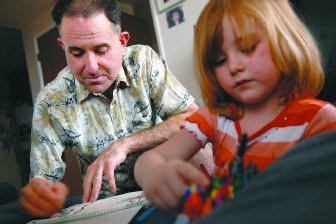
This is what Bill Schumacher’s disease has cost him: His job. His family. His health.
Trouble is, it’s hard for him to even admit that he’s sick.
Schumacher, a 40-year-old Spokane man, suffers from anorexia and bulimia – eating disorders traditionally associated with women.
“That’s part of the denial,” Schumacher says. “It’s a female disease.”
The most commonly reported statistic is that men make up just one-tenth of eating-disorder cases. But Harvard researchers announced earlier this year, in the first national survey of eating disorders, that men account for up to a quarter of all anorexia and bulimia patients.
“I think men are underdiagnosed because they don’t present for treatment,” says Dee Myers, a licensed mental health therapist in Spokane who has worked with people with eating disorders for a decade. “There are definitely men that struggle with eating disorders.”
And Bill Schumacher is most definitely struggling.
Three years ago, he weighed more than 300 pounds. Then he entered alcohol treatment, watched his marriage dissolve, and he felt guilty for all of it. So, to punish himself, he stopped eating.
He lost 112 pounds during his three months in the in-patient treatment center.
A picture taken at Christmas that year shows him gaunt-faced and pale, sitting with his young daughter in her fuzzy bathrobe. He thought losing weight would solve all of his problems, but, he says, “I’m as miserable now as I was at 310 pounds.”
He has been hospitalized too many times to count – usually when his potassium level dips so low his heart begins beating erratically.
He used to work in TV and even directed the morning and afternoon news programs at KREM before going to rehab.
He sends cards and letters to his extended family, he says, but they haven’t responded for more than a year because they’re burned out over dealing with his illness.
“The eating disorder just took it all away,” he says.
Schumacher says he has never encountered another man with anorexia or bulimia except online. At support groups in Spokane, though, he says he can completely empathize with fellow sufferers who are women.
Whether male or female, people with anorexia and bulimia tend to show similar symptoms and respond to similar treatments, says Doug Bunnell, a psychologist and outpatient clinical services director for The Renfrew Centers, a group of eating-disorder clinics on the East Coast.
But men and women often differ when they talk about their bodies and what parts they want to change.
“There are some differences in body dissatisfaction,” Bunnell says.
“Women worry about their waist down, and men worry about their waist up. It’s more often the case that (men) are not looking to lose weight; they’re really trying to defend against gaining weight.”
Schumacher had been overweight for much of his life. Most of his family is heavy, too, he says. He was teased and tormented about his weight.
“I just don’t want to be heavy anymore,” he says. “I’ve been singled out for being fat.”
But, as is characteristic for people with eating disorders, Schumacher says, “I’ll never be satisfied.”
When he sees obese people, he says, “My very initial thought is that I would rather be dead.”
To try to understand Schumacher’s disease is to try to understand something even he admits is illogical.
Schumacher is smart, articulate, likable. High-functioning, he says.
And yet, it is this simple: He is afraid to eat.
The fear begins when he first feels hunger pains. The terror builds when he thinks about what to eat. And so he doesn’t eat anything, maybe a bite here or there, until his body so desperately needs food that he binges at fast-food places and then purges.
“It’s a totally irrational equation,” he says.
He’s not making a choice, he says; it’s a behavior that’s beyond his control.
He sees counselors, a nutritionist, a doctor.
He hasn’t been hospitalized for the past 13 months and has kept the same job for half a year, progress to be sure. But in the last month he has dropped 20 pounds from his already slim frame.
The weight came off because he has been working the night shift, he says, as one of the managers of a downtown hotel. The lack of contact with others and strange hours have sent him sliding back. But he is changing his schedule in coming days, he says.
He has told his co-workers about his illness and wanted to come forward so other men suffering from eating disorders would know they are not alone.
Schumacher dreams that one day he’ll wake up and he won’t have to be scared of eating breakfast. He also hopes he won’t get so sick that his heart just gives out, becoming a victim of what is considered the deadliest mental illness.
“I will not be that tragedy,” he says. “I will not be that statistic.”