
GOP hopefuls face off
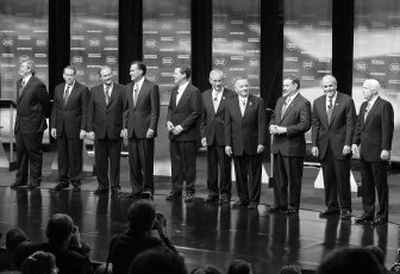
SIMI VALLEY, Calif. – Republican presidential candidates diverged sharply on abortion, stem cell research and immigration in their first nationally televised debate Thursday night, with the three leading candidates all forced to defend current or past positions that are anathema to many in the party’s conservative base.
Former New York Mayor Rudolph Giuliani was the only Republican candidate on the stage to equivocate over whether the Supreme Court should overturn Roe v. Wade, the 1973 decision that legalized abortion nationwide, and to restate his support for abortion rights.
Giuliani and Sen. John McCain, of Arizona, were in the minority in expressing support for federal funding of embryonic stem cell research, while former Massachusetts Gov. Mitt Romney was pressed to explain why he has shifted from supporting abortion rights in the past to opposing them as he prepared to campaign for the White House.
The GOP candidates found much to agree on when the questions turned to foreign policy, with all but one, Rep. Ron Paul, of Texas, supporting President Bush’s troop buildup in Iraq and taking a hard line against Iran’s pursuit of nuclear weapons. But they were critical of the president’s management of the war. McCain also made clear that he would have been far tougher in restraining spending than Bush has been.
The debate produced no clear winners or losers. The three candidates who top most national polls – Giuliani, McCain and Romney – made forceful presentations, but those struggling for attention also generally acquitted themselves well.
Giuliani appeared most out of step on the social issues. To compensate, he cited his mayoral record, saying he had governed as a conservative by cutting taxes and shrinking welfare rolls and reducing crime.
McCain generally sought to emphasize his conservative credentials, but also bragged about his ability to reach out to Democrats, though his answers were often drawn straight from his stump speeches. Romney, in his first opportunity to present himself to a national audience, was animated as he fielded questions.
The debate was exceedingly freewheeling, with scores of questions from moderators Chris Matthews of MSNBC and John Harris of The Politico, supplemented by questions from Americans across the country who had e-mailed their queries over the past few weeks.
Thursday’s debate featured 10 Republican candidates: McCain, Giuliani, Romney, former Wisconsin governor Tommy Thompson, Paul, Kansas Sen. Sam Brownback, former Arkansas Gov. Mike Huckabee, former Virginia Gov. James Gilmore, California Rep. Duncan Hunter and Colorado Rep. Tom Tancredo.
The divisions within the party were most evident when the topic of abortion was raised early in the debate. Matthews asked each of the 10 candidates if it would be a good day for America if the Supreme Court overturned Roe.
Brownback said it would be “a glorious day of human liberty and freedom.” Gilmore called Roe “wrongly decided,” while Tancredo said it would be “the greatest day in this country’s history.”
When Giuliani got his chance to respond, he replied, “It would be OK,” but went on to say it would also be OK “if a strict constructionist judge viewed it as precedent and I think a judge has to make that decision.”
Pressed later to explain his overall position on abortion, he said, “In my case, I hate abortion. I would encourage someone to not take that option.” But he then added, “But ultimately, since it is an issue of conscience, I would respect a woman’s right to make a different choice.”
With several of the candidates talking about their consistent opposition to abortion, Romney was asked about why he had changed his position. “I took the same course that Ronald Reagan and George Herbert Walker Bush and Henry Hyde took, and I said I was wrong and changed my mind and said I’m pro-life,” he said. “And I’m proud of that, and I won’t apologize to anybody for becoming pro-life.”
McCain joined Giuliani in parting company with the others on stem cell research. Acknowledging the presence of Nancy Reagan, who has campaigned for federal support for such research, McCain said, “This is a tough issue for those of us in the pro-life community. I would remind you that these stem cells are either going to be discarded or perpetually frozen. We need to do what we can to relieve human suffering. It’s a tough issue. I support federal funding.”
Immigration also divided the candidates. McCain is the most prominent advocate of a comprehensive solution combining border security with a path to citizenship for illegal immigrants, but others stressed their belief that simply enforcing the current law without providing a path to citizenship is the right policy.
“That means let’s build that border fence,” Hunter said. “When people want to come into this country, let’s ask them to knock on the front door.”