
Filmmaker to take RVers on journey through Alaska

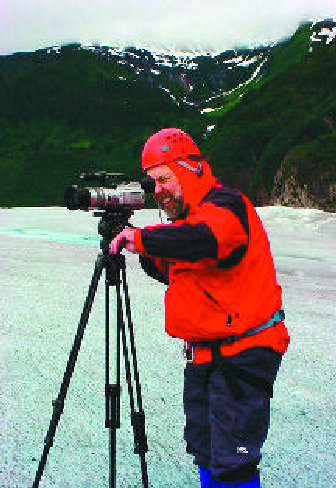
Travel filmmaker John Holod shot his first travelogue with an old Bell and Howell Super 8 camera when he was 11 years old.
He was riding on the back of his dad’s Harley Davidson as they trekked from Detroit to New York City for the 1964 World’s Fair.
“I was filming over his shoulder as we bounced along the Pennsylvania Turnpike,” reminisced Holod from his home base in Tucson, Ariz., where he and his wife, photographer Jodie Ginter, live in a park model RV.
Almost nine years later, a 20-year-old Holod made his first road trip to Alaska.
Again he was rumbling along on a Harley-Davidson, this time exploring North America by himself.
During that summer of ‘73, Holod covered more than 17,000 miles, riding from Detroit to St. Louis, to Tijuana, up the West Coast, through Washington and the Canadian Rockies to Alaska and back home.
“In 1973 the Alaska Highway was 1,400 miles of dirt road once you left the pavement north of Edmonton, Alberta,” he said. “Of course, back then I was a lot younger and a little tougher.”
That was Holod’s first real adventure away from home.
“It changed my life forever,” he says. “I have been traveling ever since.”
In the late 1990s, Holod returned to Alaska to film his original motorcycle route. He decided to leave his bike at home and traveled in the “luxurious comfort” of a 34-foot Fleetwood Discovery motor home.
“An RV is a perfect way to enjoy the highway and Alaska,” says Holod. “You can stop where you want, eat what you want and sleep when you want. There was also plenty of room for my camera and editing equipment.”
From that trip he produced “Alaska RV Adventure: The Last Great Road Trip” and “Alaska’s Inside Passage,” two of his most popular travel DVDs.
“That year I became a full-time RVer,” he says. “For the next decade I averaged 50,000 miles a year.”
This summer, Holod and Ginter are returning once again to The Last Frontier.
In mid-May they leave for a four-month trip in a brand new 2008 26-foot Born Free class C.
They plan to shoot new footage for their two RV DVDs and put together a third travelogue on the back roads of Alaska, the Yukon and British Columbia.
If you’re dreaming of someday taking an RV adventure to Alaska, it’s never too early to start gathering research.
Planning begins here
To recap, the Alaska Highway begins in northeastern British Columbia at Dawson Creek, it then meanders northwesterly through the Yukon Territory and into the heartland of Alaska—a length of about 1,460 miles. Add to that, depending on your route, between 825 miles and 950 miles between Spokane and Dawson Creek for a total of 2,285 to 2,410 miles from the Lilac City to Fairbanks, not including side trips.
Gas is a bit more expensive in Canada (as high as $3.85 per gallon in Dawson Creek), and a bit cheaper in Alaska (as low as $2.56 in Fairbanks), compared to Spokane.
Consider taking the Alaska Marine Highway ferry one way through the Inland Passage.
“We suggest people drive up and take the ferry back,” says Holod.
“If you are going to go all the way to Alaska, whether from Spokane or Florida, you might as well see both the interior and coastline.”
Drive-on ferry service operates between Bellingham and Prince Rupert, B.C., in the south to the Inland Passage cities of Ketchikan, Wrangell, Petersburg, Sitka, Juneau, Haines and Skagway.
“Aesthetically it is more interesting to drive to Alaska,” says Holod. “People enjoy counting down the miles getting to the border.”
RVers can take in the incredible scenery of interior and visit Anchorage, Denali, the Kenai and the Arctic. Then soak up the magnificent beautiful of the coastline on the return.
“To me the coastline is way more spectacular than the highway,” says Holod. “It’s a great trip and you can visit all the little towns along the way.”
Many people board the southbound ferry in Haines, about 150 miles from the Alaska Highway and 600 from Fairbanks.
A rough cost estimate is $2,250 for the 62-hour trip between Haines and Bellingham for a 21-foot RV ($1,185 plus each additional foot is $65) and two persons ($684) with a cabin ($381). Rates increase 3.2-percent for all travel commencing July 1 and later.
Due to U.S. Coast Guard regulations, passengers cannot sleep in their vehicles and can only access them while the vessel is stopped in ports. Often passengers choose to sleep in their own sleeping bags in reclining chairs on deck instead of renting a cabin.
Vehicle and cabin space sell out quickly during the summer season.
“ Reservations and ticketing agent for Alaska Marine Highway is Alaska Ferry Adventure, www.akmhs.com or call (800) 382-9229.
“For information on the Alaska Highway system go to www.dot.state.ak.us .
Alaska information
“For a free Alaska State Vacation Planner, contact the Alaska Travel Industry Association at www.travelalaska.com or write to ATIA, 2600 Cordova St., Suite 201, Anchorage, AK 99503.
“For Mount McKinley and Denali National Park visitor information, contact the Park Superintendent’s Office, P.O. Box 9, Denali Park, AK 99755, (907) 683-2294, www.nps.gov/dena.
“The National Parks of Canada is www.pc.gc.ca, from there you can access information on parks along the highway.
“”Alaska RV Adventure: The Last Great Road Trip” and “Alaska’s Inside Passage” DVDs are available through John Holod Productions at www.johnholodproductions.com or call: (877) RV-ESCAP (877-783-7227).
“”The 2007 Milepost: Trip Planner for Alaska, Yukon Territory, British Columbia, Alberta & Northwest Territories” (Morris Communication Corp., $27.95). The 59th Edition is available at most book stores or through online book sellers or the Milepost Web site at www.milepost.com or by calling (800) 726-4707.