
NET GAINS
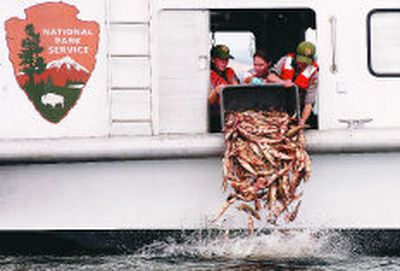
As his sleepy-eyed crew sips tea, reads or stares out at the gray dawn rain, Phil Doepke guides the 33-foot Freedom from the shore of Yellowstone Lake toward a distant island. This is a day, he hopes, when they will make a killing in Yellowstone National Park.
Navigating the depths of the lake are vast numbers of ravenous lake trout, a foreign species that in recent decades has decimated the lake’s native Yellowstone cutthroat. Doepke’s job is leading his crew in a concerted effort to kill as many lake trout as possible.
Last year, more than 50,000 lake trout were pulled up in nets, killed and sent to the lake’s bottom. Since 1998, more than 190,000 have been killed in one of the most intensive efforts in a national park to get rid of an exotic predator.
Last summer on the lake produced unprecedented catches, with days when 800 lake trout were plucked from the water, including a record-setting 24-pound giant in September.
“We’re certainly making a dent,” Doepke says over the boat’s churning engine.
The question is whether it will be enough to save Yellowstone’s iconic cutthroat trout.
In recent years, the number of Yellowstone cutthroat in the lake has spiraled precipitously downward.
The number at one counting station dropped from 2,300 in 1999 to zero in 2005. On the eastern shore, where 70,000 spawning cutthroat were counted in the late 1970s, only 917 were seen last year, the lowest number since record keeping began in 1945.
Although the ongoing drought and whirling disease have played a role, the lake trout has been the biggest troublemaker.
Illegally introduced to Yellowstone Lake sometime in the 1980s, mature lake trout are notorious for gobbling up cutthroat. Each is capable of eating about 40 of the fish a year.
After lake trout were discovered in Yellowstone Lake in 1994, experts knew they had to stage a counterattack.
Several ideas were discussed, including introducing sterile sea lampreys, a parasitic eel-like fish that latches onto a lake trout or other fish and bores a hole in its body, killing the prey.
Worried about bringing in one exotic fish to battle another, though, fishery experts thought better of the idea. Instead they recommended an industrial-strength gillnetting program, similar to what commercial fishermen use, to save the cutthroat.
It wouldn’t be a one-year or two-year fix, though.
“At the time, everyone acknowledged that it was truly a ‘forever’ proposition,” says Lynn Kaeding, one of the experts at the meeting who is now a supervisory fisheries biologist with the U.S. Fish and Wildlife Service in Bozeman.
The gillnetting program now costs about $400,000 a year.
Fishery officials think they’re starting to see signs that it’s making a difference, but they don’t pretend they’ll ever get rid of all the lake trout. The idea is to keep pinching the population so that cutthroat can bounce back and survive.
Letting up, even for a summer or two, could be disastrous.
“It’s like dumping garbage cans,” Kaeding says. “It’s something you have to keep doing.”
At any one time in the summer, there are 14 miles of gillnet in the lake.
About 40 percent of the fish that come into the boat are dead. The others are whacked on the side of the table.
Occasionally, Yellowstone cutthroat are caught, too. When they’re alive, getting them out of the net becomes the top priority for the crew so the fish can be placed into a container of water and, if they recover, returned to the lake.
Over the course of the morning, the crew pulls up net after net, gathering more than 500 lake trout by lunchtime.
The air bladder on each is sliced so that, when it comes time to dump the fish over the side of the boat, they’ll sink to the bottom.
Killing huge numbers of living things inside a national park — ostensibly places to preserve wildlife — may seem strange, but those who do it keep their focus on trying to save the native trout.
“Nobody’s out there just to kill fish,” says Patricia Bigelow, a fisheries biologist who oversees the gillnetting program at Yellowstone. “They’re there because they love fish.”
Losing the cutthroat in Yellowstone Lake, long seen as a stronghold for the fish, would have unknown and possibly severe ripple effects.
For the past 10,000 years or so, ever since the melting of the last ice age, the cutthroat has shared the lake with only the longnose dace.
Over the centuries, grizzly bears, eagles and other animals came to rely on the cutthroat’s annual spawning trip to shallow riverbeds, where they could be easily snatched for a quick meal.
Today, park officials estimate that about 40 species in Yellowstone feed on the fish.
Lake trout aren’t a suitable replacement because they tend to spawn in the fall in deeper places, out of reach for most species.
“It has the potential to be an ecological disaster,” a Park Service report noted in 2003.
Unabated, the lake trout population could eliminate 90 percent of the cutthroat in Yellowstone in 20 years, park officials predicted in 1996.
A cutthroat population that once numbered in the millions has already been reduced to a fraction of that.
There are other ideas being considered to reduce lake trout, including development of a scent that will draw spawning lake trout together in a place like West Thumb, where they could be netted more easily.
Engineering students at Montana State University have also developed proposals for a powder that could be dumped at spawning grounds that, once it hits water and lake trout eggs, creates a gelatinous seal that smothers the eggs.
“Lake trout seem to spawn in a relatively small area,” says Al Zale, leader of the Montana Cooperative Fishery Research Unit in Bozeman. “If something could be done to the eggs in that area, that would be a way to reduce their success.”
For now, though, the front lines in the battle against lake trout will be on boats like the Freedom and the seemingly endless string of nets it pulls out each day. It may be years before the biologists know whether they’ve fully tipped the scales in favor of the native cutthroat.
“The question isn’t whether we’re having an effect,” Bigelow says. “It’s whether we’re having a big enough effect.”