
A frantic balance
Of all those who have commented on the relationship between mental illness and artistic creativity, the 17th-century English poet John Dryden may have described it best.
“Great wits,” he wrote, “are sure to madness near allied, and thin partitions do their bounds divide.”
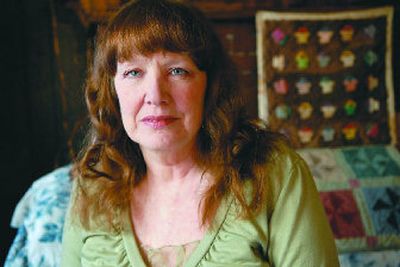
Teresa White knows the meaning of Dryden’s words. She’s lived them.
White, a Seattle native who has spent the last decade living in Spokane, has published two books of poetry: 1997’s “In What Furnace?” and the just-released “Gardenias for a Beast” (Two Steps Publishing, 242 pages, $10.99 paper), from which she read at Auntie’s Bookstore on April 24.
And she’s written both books despite having battled bipolar disorder. Once known as manic depression, bipolar disorder can cause severe mood swings, from depression to mania and back, sometimes in a single day.
In its worst manifestations, bipolar disorder can result in hospitalization. Most experts agree the problem can grow worse if it goes untreated.
White, 60, first began showing signs of being bipolar when she was an 18-year-old freshman at the University of Washington.
“But the illness wasn’t diagnosed until I was almost 40,” she says.
The illness’ onset surprised her as much as anyone.
“It was my first quarter and I did not know what hit me,” White says. “But needless to say, that was the beginning of a long series of lengthy hospitalizations.”
She estimates that she’s spent a total of almost seven years in various hospitals. Her most recent 10-day stay came just eight months ago.
“When we go into that schizoid state we might as well be schizophrenic because we’re in psychosis,” White says. “We can’t tell what’s real from what’s not. We really need to be hospitalized because our meds need to be increased, sometimes doubled.”
White won’t say that her condition drove her to write poetry because, she points out, she began writing at age 12.
“So to say that I never would have written without the disorder would be erroneous, really,” she says. “But whether or not I would have kept writing. …
“See,” she adds, “a lot of young, adolescent girls write poetry. They write, ‘Oh, my boyfriend left me and I’m going to cry, la-la-la.’ That’s common. It’s a phase they go through.”
White, however, continued scribbling her thoughts on paper.
“It just became something that I did,” she says. “Every day. I always carried around a pad and pencil. And I thought nothing of it. I felt like, ‘Well, doesn’t everybody?’ “
According to an article on a British mental-health Web site ( www.mentalhealth.org.uk), “There is good evidence that many creative people throughout history have had experience of bipolar disorder, including eminent academics, artists, writers, poets and actors.”
White’s medical prescriber, registered nurse practitioner Illa Hilliard (ARNP), agrees.
“On the whole,” Hilliard says, “we know that people who are bipolar are exceptionally, unusually bright and creative. Not all, but many.”
“Gardenias for a Beast” is a collection of 234 poems that, while mostly short glimpses at the world as White sees it, come in different styles. Some are rhymed, some are free verse. Some are personal, some are universal.
All impressed former U.S. poet Laureate Billy Collins, who wrote this about the book: “More impressive than Teresa White’s light touch on the tragic and her way of keeping her reader pleasurably off-balance is the fact that no word is wasted here. Every morsel of her diction counts. And she knows how to cut a line with unerring accuracy. She is a poet who not just deserves but requires our attention.”
Here’s an example titled “Bus Stop”:
“Up the street
pale yolks of headlights
advance in fog.
Down the street
the blue-gray sigh
of trees can be heard.
I find a coin
in the deep country
of my pockets.
A man walks over
but doesn’t stand close.
This territory is gridded out;
we never cross the line.
My toes flex and unflex
in their paper shoes;
my hands share one mitten.
Surely there is love somewhere.”
White’s illness robbed her of an education, something she says “I’ll go to my grave regretting.”
But being bipolar “doesn’t mean I got to sit home and knit. I mean, I still had to go out and, like everyone else, get a job.”
So she learned office skills through the Washington State Dept. of Vocational Rehabilitation and, over the years, she says, “worked when I could.”
It was 10 years ago that, tired of Seattle traffic, White and her husband of 35 years – former master exterminator Rob White – moved to Spokane. Besides enjoying better traffic patterns, and being nearer to her daughter and grandchildren, living east of the Cascades gave her the opportunity to retire.
“The doctor finally told me, he said, ‘Teresa, throw in the towel, dear. You’ve shown the world that you can work,’ ” White says. “He said, ‘You’re tired. Give yourself a break.’ “
That break led directly to her writing some 500 poems, the basic material that makes up “Gardenias for a Beast.” And it gives her the opportunity to thank the woman, herself a Shakespearean scholar, who first pointed White toward the magic that words can create.
“When people ask me why I write poetry or how did I get started,” White says, “there’s one thing that is very, very crucial to know: Without being born to the mother I was born to, I doubt that I would ever have started writing poetry.”
“Madness,” as Dryden would put it, may be tied to wit. But it clearly doesn’t overshadow gratitude.