
A new family tradition
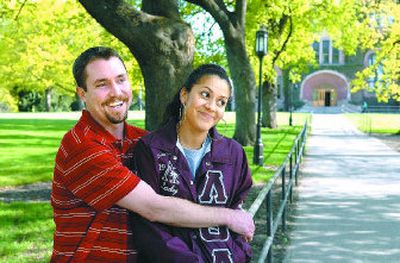
MOSCOW, Idaho – When Lucia Venegas Christensen is handed her University of Idaho diploma here Saturday, her husband will be watching the clock.
She wants to be the first in her family to graduate from college, and she doesn’t want to fall behind her little sister, who’s walking at Boise State University at roughly the same time.
Whoever graduates first, though, Saturday will be a big day for Venegas Christensen and her family, who migrated from Mexico and worked in the fields in Idaho and Oregon. In addition to Venegas Christensen and her sister’s commencements, they have a brother graduating from high school.
“So three graduations,” she said. “Oh, and my little brother’s graduating from middle school. Let’s not forget that.”
All this graduating is a new family tradition. Neither of her parents has more than a sixth-grade education, and they didn’t foresee college for their children, Venegas Christensen said.
“I never thought that I was going to make it to college,” she said. “I thought if I got a nice job at a restaurant, that would be it.”
A federal program aimed at helping children of migrant families showed her college was within her grasp, she said. The College Assistance Migrant Program helps immigrants who are citizens or permanent residents with scholarships, tutoring and other assistance before and during their freshman year.
In Venegas Christensen’s case, a CAMP scholarship helped her get started, and then her academic record – she’s graduating with a 3.7 grade-point average – drew in enough scholarships to pay for the rest of her education.
There are hundreds of CAMP students at Inland Northwest universities. Twenty-eight will earn bachelor’s degrees Saturday from the UI, and the school will confer its first master’s degree on a CAMP student. Nationally the program, run by the Department of Education, serves about 2,400 students a year.
Another UI CAMP graduate, Cecilia Alcala Barajas, credits the program with providing a support system that first-generation college students often don’t have. She’s been studying in Spain; in a written correspondence with the UI communications office, she said it’s particularly important to have CAMP on a campus like the UI’s, which is more than 80 percent white.
“I couldn’t believe the lack of diversity on this campus,” she wrote. “It was very difficult to pay attention in classes when I noticed how few minority students there were in my classes. It was quite a challenge to overcome. I think this was a greater challenge than anything else, knowing that you are the only Mexican woman in a class.”
She wrote that the CAMP program provided a family atmosphere, as well as lots of practical help like tutoring, and that thanks partly to the program she’s had a “wonderful time” at the UI. She plans to go on to law school after graduation.
Venegas Christensen also has plans for graduate school. She’s been accepted into the school counseling program at BSU, and she wants to help Hispanic students who may know as little as she did about college.
“When you go into public schools, there are not a lot of expectations, especially for Hispanic students,” she said. “That kind of becomes a self-fulfilling prophecy. The low expectations they have about you – you tend to act on them.”
She experienced this firsthand after moving from Guadalajara, Mexico, to Kuna, Idaho, seven years ago with her mother and four siblings. Her father had already come to the U.S. and established citizenship; she and the rest of her family became permanent residents.
In her school district, there was a single instructor for English as a Second Language, though the region has a large population of immigrants and seasonal workers. She only began considering college after attending a leadership conference for Hispanic students as a high school senior in Nyssa, Ore.
She enrolled at the UI in 2003, moving to Moscow with her husband of several days, Chris Christensen, who enrolled in law school and is receiving his law degree in this weekend’s ceremony.
They’ll be among more than 1,700 graduates receiving diplomas Saturday, when the school expects to award its 100,000th degree.
But it will be Lucia’s graduation that’s timed to the minute.
“We’re going to be watching the clock to see when she gets that diploma in her hand,” Chris Christensen said.