
Long’s road back
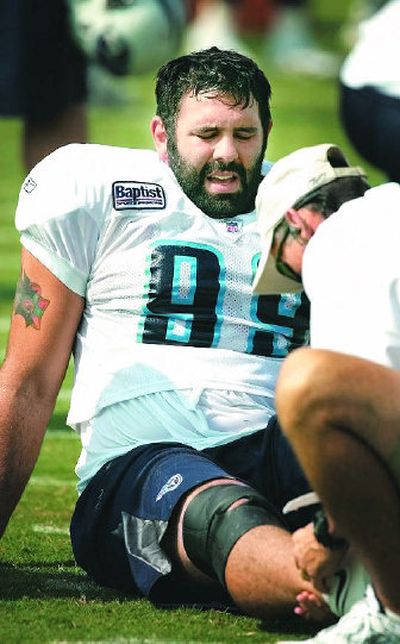
When Tennessee Titans defensive tackle Rien Long ripped up his right Achilles tendon last summer during an innocuous drill on the first day of training camp, he knew it would be a treacherous road back.
What he couldn’t have known then was that a staph infection months later would complicate things further. In fact, doctors later told him there was one 24-hour stretch in which they worried he might lose his right foot.
Titans veterans have been working out together since April 19, but Tuesday they took the field for their first official minicamp practice of the off-season. Long wasn’t with them. He was still be patrolling the outskirts of a football practice, an outsider wishing he could be part of things.
“You’ll see some creepy dude salivating on the sideline, wanting to get back out there,” said Long, who won the Outland Trophy while at Washington State University. “That’ll be me.”
Long will continue lonely rehabilitation work, eager to be part of the next series of sessions in June, although he may not be ready to go full speed until training camp opens in late July.
An effective interior pass rusher, Long might be an important piece for a defense looking to move up the league’s defensive rankings. The Titans ranked last in 2006.
Despite Long’s account of the staph infection and resulting treatment, Titans coach Jeff Fisher said “at no time” was losing the foot a concern.
“It was a highly unusual thing, a difficult injury from a coping standpoint,” Fisher said. “He had a setback before he had the staph infection. As we speak right now, most of it’s behind him. … He should be good to go without any issues at all by training camp.”
As with many of his colleagues around the NFL, Fisher has become increasingly reserved in talking about injuries, even during the off-season.
No medical officials connected to the team were available to discuss Long.
Long said he was told most serious Achilles injuries render that area of the foot looking like something blew up inside, but his was different – a clean slice that he was told would actually make it easier to repair.
But the first setback prompted a second operation, likely setting the stage for the complications.
Long said he somehow aggravated the Achilles while going up some stairs. When doctors checked it out, they decided it needed to be “re-tightened,” Long said.
According to Dr. William Schaffner, a Vanderbilt infectious disease specialist with no specific knowledge of Long’s case, repeat surgeries at the same anatomical site severely limit or stop blood flow to the scarred area, thus increasing the possibility of staph infections.
Williams said staph is a bacterium that 20 percent to 30 percent of all people carry in their nasal cavities or even on their bodies, and infection is a risk in any surgical procedure.
When the infection occurred, Long said he felt and saw something was wrong. A day later, he wasn’t feeling well. The area that had been surgically repaired was especially sore. He was given antibiotics and told to report back if it got worse.
It did.
“That next day it was nasty – it was purple, just oozing stuff,” he said. “It was just disgusting, swelled up. It felt like someone was holding a lighter behind my Achilles.”
He was rushed into surgery to clean it out.
Only after the fact did he learn just how dire his situation might have been.
“They told me (there had been a point where) we’d have to wait and see in the next 24 hours if my foot would still be attached to my body,” Long said. “They didn’t know if they were going to have to cut it off or not. Luckily it just ate away the skin and we caught it early enough, it didn’t get into the Achilles or anywhere else …”
“Wow. I went from ‘I can’t wait to get back for next season’ to being thankful I’ve got a foot to walk on.”
When Long got out of the hospital, doctors hadn’t closed the gap in the back of his leg.
Schaffner, the Vanderbilt doctor, said such wounds typically cannot be closed, as they must heal from the bottom up.
Long said he carried around a medical device that he described as a mini vacuum cleaner, whose constant suction literally helped hold things together.
The skin is still healing, Long said, but he has functionality of the repaired muscle.
“The Achilles is fine. I’m running around doing normal stuff,” he said.
The 2006 season was supposed to be a breakthrough year for him. If he continued to emerge as a consistent pass-rushing force, he might have positioned himself for a significant payday as an unrestricted free agent.
Instead, everything got pushed back a year, and he signed a one-year deal to return.
“I can’t wait to get back on that field and do what I used to do,” he said. “It’s like I got held back. It’s like I’ve got to repeat the fourth grade. I’ve got to do it over again.”