
Just like the Shock

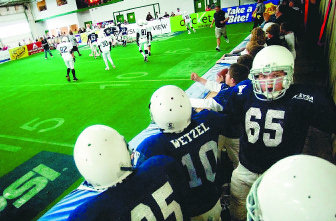
About a year ago, the arenafootball2 league expansion Spokane Shock began its successful championship quest and gave the city a nice buzz.
So it is hardly surprising that after the successful season, there is a trickle-down effect.
Like the Shock games, where sellouts at the Spokane Arena are routine, interest in the kids’ version of the indoor football game has spread like an electrical current in water.
Program coordinator Josh Guthmueller of the downtown YMCA said the 16 teams were filled in just two weeks, “and that was without any advertising.” There’s a waiting list to play.
The teams play at the Shock Center – one of the buildings at the former Planet Ice skating facility that closed earlier this year in Spokane Valley.
The league is divided into two divisions, fifth- and sixth-graders and seventh- and eighth-graders.
Teams represent a wide variety of school attendance areas, ranging from Shadle Park, Lewis and Clark and Ferris to Mead and Spokane Valley schools. The Cataldo team from the Parochial League also participates.
The five-week season began April 21. Each team has 18 players and uses arenafootball2 rules, with the exception of no field goals or extra points. The low ceilings at the Shock Center don’t allow for kicking.
“There was a need for more (kids) sports,” said Shock owner Brady Nelson, who has embraced the idea of the kids’ program. Shock coaches and players help out.
The arenafootball2 game, Nelson said, “helps develop specific skills” that may be missing from the traditional 11-man game. Arenafootball2 “is more passing-oriented,” he noted.
As for safety, Nelson said, the same high-density foam that surrounds the field at the Spokane Arena is in place at the Shock Center.
Renegades coach Marcellus Kennedy, 35, keeps his interest in the game alive by passing along knowledge he’s acquired having played or been otherwise involved in football for 29 years. An injury cut short the Norfolk, Va., native’s playing career.
Off the field, Kennedy wears the tall white hat of the banquet chef at the Mirabeau Park Hotel in Spokane Valley.
In his third season with an 11-man team in the YMCA’s Grid Kids fall football program, Kennedy jumped at the opportunity to see how he would do with the indoor game.
“My neighbors know I coach in the fall. ‘What are you doing now?’ ” they asked.” Kennedy told them he was coaching indoor football for the YMCA, and they came out to watch his team.
“Everyone in Spokane needs to know about this because it’s really exciting,” he said.
“I didn’t know much” about the indoor game,” Kennedy admits. But by combining his experience with some help from the players in the trenches, Kennedy has molded an early success.
With Jerome Stevens of the Shock helping and Kennedy “doing some research,” as he calls it, the Renegades are one of the success stories of the kids’ version of the game.
“Half of the team I’d worked with before” in the fall program, Kennedy said. “The kids understood what I was looking for.”
Developing his young charges’ football skills is one thing, but as far as Kennedy is concerned, “the main thing here is to let them have fun.”
The team has one main rule, Kennedy said. If the kids don’t practice, they don’t play.
The politics in many youth sports don’t come into play, Kennedy said, because he doesn’t have a kid on his team. “We get away from the politics of my son playing quarterback,” Kennedy said. “We treat everyone fairly.”
Assistant coach Joe Kenney doesn’t have any kids on the team either, Kennedy said, making their commitment a truly special one.
Kevin Edwards coaches for the Gladiators. The 24-year-old former Lewis and Clark and University of Montana cornerback has stepped into the role even though he, too, has no children. “My dad said it’s time to give back. There were guys who volunteered to help you,” he said.
Edwards’ main goal, like that of Kennedy, “is to have fun. I’ve seen parents getting into it on the sidelines.”
The biggest fundamental challenge for Edwards is the high-scoring nature of the indoor game. “If you miss a tackle, it’s a touchdown.”
Being an 11-man football man, Kennedy said there are many rules that have become engrained in his mind. “The technique is still going to be the same,” he said. “You’re still going to line up in the three-point stance. You’re still going to run as hard as you can, hit as hard as you can.”
But the indoor game has some rule differences. One example was last Saturday with the Renegades protecting a lead late in the game. “We had a game – probably the best game I’ve seen at that age level,” Kennedy said.
“We had the ball, and I’m telling the kids in the huddle to kneel down. Keep the clock moving,” Kennedy said. “But in Arena football, if you don’t get any positive yardage, the clock stops. I said, ‘Wow, I didn’t know that.’ “
One rule that is not in place in the kids’ version of indoor football is the big looping motion play you see at Shock games. The YMCA program does not want to confuse the kids who will return to traditional football in a few months.
To get from 11 to eight players for the indoor game, two linemen and a tight end are eliminated.
“Arena football to me is almost like basketball,” Kennedy said. “It’s a team sport, like basketball, but you tend to have a lot of one-on-one matchups. It’s a very quick, very fast game.”
If the YMCA continues with this project, Kennedy says he would like to see some of the smaller kids whose parents don’t allow them to play football turn out.
“I think those are the kids who are going to be a part of Arena football. That whole Arena football is made for the small, fast guy,” Kennedy says. “It’s really a small football player’s game.
“The best player we have on our team is probably 80 pounds,” he said.
Whatever Kennedy is doing is working. Through three games, his Renegades are undefeated. They will play at 10 a.m. Saturday.