
Pia Hansen: Memory of daughter motivates his mission

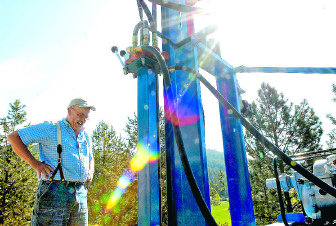
When Gary Mitchell gets up to pour me another cup of coffee, I see a wrench sticking out of the side pocket of his clean work jeans. We’ve been chatting for a while in the cozy kitchen on the Mitchell farm just north of St. Maries, Idaho.
It’s a sunny, breezy day, there are horses waiting outside and we’re talking about Africa. I’ve spent a month in Lesotho, and Mitchell has been to both Kenya and Tanzania.
After e-mailing a bit, it turned out Mitchell had something in his shop I really wanted to see: a portable water drill rig bound for Kenya.
Nope, this is not a contraption that fits in a backpack – but it does fit on a smallish flatbed trailer, making it relatively easy to ship. The technology is simple and solid, nothing too technical, and when Mitchell is done fixing it up it’ll come with a full, mounted toolbox as well.
So how does a “sort of retired” farmer and former logging contractor from North Idaho catch the Africa bug so badly he takes on a project like this?
“When you see the need there, you change inside,” Mitchell said. “And once you’ve been there to teach people and you’ve seen them learn, that’s really something. You feel like you can do something to help people and from then on it kind of possesses you.”
Earlier we were standing out in the bright sun – Mitchell demonstrating the rig, me watching, a big dog snoozing in the shade under the trailer – and it became clear to me that Mitchell is on a mission.
Mitchell is a man of great faith.
“I feel blessed, God’s hand is in this,” he said, before telling me how it all got started.
Some years ago, Mitchell got involved with Life Water International. LWI is an independent Christian organization that works on basic water and hygiene issues in emerging nations.
Mitchell went to one of LWI’s conferences.
“I was just sold. ‘These guys are changing the world,’ I thought.’ ” LWI hooked him up with a water pump repair class later, and then he headed off to Africa.
He couldn’t believe the conditions of the wells he saw.
“Women walk miles and miles to fetch water in a waterhole you and I wouldn’t even dip our feet in,” he said. After having established solid contacts with charities in Kenya, he returned with a desire to find a well-drilling rig that was simple, sturdy and easy to operate. The ideal rig was elusive, but he finally found one in Texas. After getting stuck in a snowstorm in Denver, it arrived in Idaho a couple of weeks ago.
Another LWI contact, Ron Reed, a lawyer and entrepreneur in Chico, Calif., became a surprise partner, splitting the cost of the project.
Eventually, Mitchell said, he hopes drill rigs like the one he’s shipping out can be produced in Kenya.
What a great concept: helping people to help themselves by producing something they really need.
So there we sat, each with a mug full of coffee, flipping through our own memories of Africa, when I asked Mitchell one last question: What does this project mean to you?
There was a pause. Then Mitchell told me he lost a daughter to a brain tumor two years ago – when I looked up I caught a flicker of inconsolable pain in this gentle man’s eyes.
“I guess I kind of grew up through that one,” he said, looking away. I don’t prod.
We both know what that means: Something beautiful and life-giving is growing out of his enormous loss.
Our interview ends, and I head out on a stunning trail ride with Mitchell’s wife, Patti, pondering how peculiar it is that my faraway trip to Africa has connected me to these wonderful people, living nearby.
A few days later, an e-mail pops up with the rest of Mitchell’s answer to that last question:
“After every trip that I have been on I come home feeling really blessed. I go hoping to help. I come home helped and then I realize that this is what I am to be doing. You have a child dying every 12 seconds from waterborne illness. I think in segments of children and time: Five every minute, 300 per hour, approximately 750 while we sat and visited at our dining table last Friday. We lost a daughter two years ago. I think about how much suffering went with that and still goes on. She died of an incurable disease. Those 750 (children) that died while we visited didn’t have to die, especially in this day and age.”
And that explains it all.