
Snowboarding wreck, recovery haven’t changed his goals

Jake Pereira didn’t like the snow conditions on Jan. 28. Schweitzer’s slopes warmed up just enough to melt and freeze again. So the Canfield Middle School eighth-grader and his friends decided to spend their morning jumping obstacles at the terrain park. The prior day, Jake told his dad how much he loved Schweitzer’s park, and his dad issued a warning. Don’t get hurt, and don’t miss baseball season, he said.
But snowboarding was cut short that morning. Just after 10:30, Jake overshot a jump and landed on the frigid, hard-packed snow. The events are fuzzy for him, but vivid to his parents who received a cell phone call from Jake’s younger brother. Levi didn’t see the fall but was at his brother’s side immediately. He called their mother, Pam, at their mountainside condo, and they located Jake’s father, Kris, who was skiing on the backside of the mountain. Kris was there in time to help load his son onto the gurney to travel to the first-aid station.
“The Schweitzer ski patrol did a phenomenal job,” Kris said. “They probably saved him from more severe injury.”
Jake was transported to Bonner General Hospital, where it became apparent that his injuries were complicated. He had a concussion and fractures to his right hip, left femur and several vertebrae in his neck and back. His acetabulum, the cup-shaped bone holding the hip joint together, was broken in four places. An urgent plane ride to Harborview Medical Center brought Jake to a physician who performed similar surgeries about 100 times per year, but rarely on a child. Doctors made no promises about how well he would recuperate.
“We knew he wouldn’t be permanently paralyzed, but we didn’t know the extent – if he would have a limp or nerve damage,” Kris said.
Jake was sedated on pain medications for several days, so didn’t realize for awhile where he was and what had happened.
“It was kind of a blur,” he said.
Certain memories linger: his mother constantly by his side sleeping in a chair, a classmate visiting and phone calls from friends back home. Doctors shot electric currents through Jake’s legs to test for nerve damage, and likened his fall on the ice to dropping from a 50-feet-high wall onto concrete. They told Jake he was lucky he wore a helmet.
“They say it saved my life,” he said. “I would have died without it.”
Jake endured two surgeries, one to place a rod in his broken femur, and another to reconstruct his hip with plates and pins. He spent six weeks in a neck brace and returned to school in a wheelchair. Warnings were issued to the student body not to bump into him and to handle him with care.
As a sports enthusiast who was quarterback on an undefeated football team and played state-championship baseball, Jake had to make quick adjustments.
“It was really different than what I was used to,” Jake said. “I had to figure out new ways of doing things.”
He learned that not every place he wanted to go was wheelchair accessible, nor was every bathroom handicap-accessible.
“I can relate to people who have to be in a wheelchair,” he said.
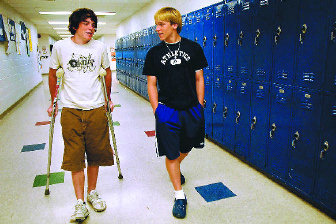
After much physical therapy, Jake recently graduated to crutches and looks forward to the day he can participate in the sports that he loves.
“I feel fine,” he said. “Life’s getting back to normal.”
To Jake’s friends and family, some things have been remarkably “normal” through the whole ordeal. Friend Kyle Siegwarth was supposed to be on the slopes that day in January, but was doing homework instead. When he saw Jake after the accident, it was not what he expected.
“It was almost like nothing happened,” Kyle said.
Jake kept true to his sense of humor and convinced his friend that doctors planned to insert a leg extension. Jake would come out of surgery 6-feet 2-inches.
“He made it sound so convincing,” Kyle said.
Jody Hiltenbrand teaches Jake’s advanced language arts class and believes he is a source of inspiration to classmates and faculty with his courage, determination and strength.
“Since he returned I have not heard Jake utter one complaint,” she said. “Not one. He maintains a positive attitude and remains honest, hopeful and uplifting.”
From Jake’s perspective, there are more reasons to be grateful than there are to complain. His family was by his side through everything. His dad learned to give blood-thinning shots, his mom was always there to listen when emotions ran high, and his brother provided comic relief and video game diversions. Teachers offered make-up work and patience, his school counselor provided safety checks, and friends carried books and opened doors.
“I learned what great friends I have and how nice my teachers can be,” Jake said.
He has yet to get back to some of his favorite things, like running, jumping on a trampoline, wakeboarding and yes, even snowboarding. He plans to return to Schweitzer, although more cautiously, and rates this winter as the most fun ever, thanks to the 30 days of snowboarding he got in before his injuries.
The accident hasn’t changed Jake’s goals for the future, but has increased his desire to do what he wanted to do all along: Play professional baseball. He has expanded his list of life’s pleasures though to include being upright and showering.
“I have a new appreciation for simple things like walking,” he said.