
Making their pitch

When Oregon State University battled through six elimination games and eventually knocked off North Carolina to win the 2006 College World Series in Omaha, Neb., last spring, it injected a much-needed dose of optimism into cold-climate baseball programs across the country.
In becoming the first northern-based team to win the NCAA baseball championship in 40 years, the Beavers proved to young recruits everywhere that you can go north – or stay there, if that’s the case – and successfully compete against perennial national powers from more weather-friendly areas such as the Deep South, Texas, Arizona and California.
What OSU’s magical title run didn’t do, apparently, was alter the long-held opinion that most cold-weather schools, such as those in the Pacific Northwest, still don’t belong among the country’s elite. Because of the teams listed in this week’s Baseball America Top 25 poll, only four – Missouri, St. John’s, Michigan and Creighton – classify as northern-based schools.
That obvious lack of respect has not gone unnoticed by the coaches at the two NCAA Division-I universities in the Spokane area. But Gonzaga’s Mark Machtolf and Washington State’s Donnie Marbut are hopeful that college baseball’s national psyche might be changing – particularly in the wake of Oregon State’s successful ride.
“I think anybody would be lying if they didn’t say they were at least a little bit surprised,” Machtolf said of OSU becoming the first northern-based CWS champion since Ohio State locked down the national title in 1966. “But they had a very good crop of Oregon kids they were able to keep at home, and they did an outstanding job.
“And I think if you talked to any coach in the Northwest, he’ll tell you that’s the goal. That’s the thing we’re all trying to accomplish, but it’s a little more difficult at northern schools.”
The problems faced by coaches at cold-weather institutions range from trying to sell recruits on playing early-season home games in the rain and cold to having to practice indoors – during the worst of years, at least – throughout February and much of March.
But those problems, Machtolf and Marbut insist, are not insurmountable.
Their opinions have been validated by the strong seasons their teams put together this spring.
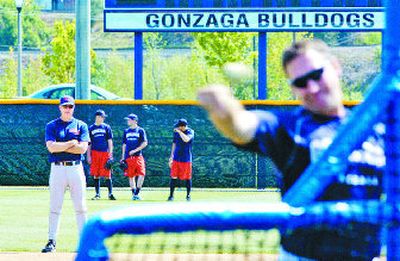
Machtolf’s Bulldogs, after finishing the regular season 32-23 overall and 16-8 in the West Coast Conference, are on their way to San Diego this weekend to take on the conference champion and fifth-ranked Toreros (41-16, 18-3) in a three-game championship series that will determine the WCC’s automatic berth in the NCAA playoffs.
Marbut’s Cougars, with three non-conference road games against UC Davis remaining, are 27-24 overall and in sixth place – ahead of defending national champion OSU – in the Pacific-10 Conference standings with a 10-14 record.
WSU, which took two out of three games from UCLA last weekend, is getting it done predominantly with kids from the Pacific Northwest, while Gonzaga has managed to pick a few recruiting plums out of Arizona and southern California.
“What Oregon State did was remarkable,” Marbut said. “And they did it with Northwest kids they were able to keep at home. We feel like we can be in that situation, too, if the kids we’ve signed show up for college instead of staring their pro careers.
“It’s still all about the players, and I don’t think people should forget that. If we can keep the top players in the Northwest here, we can compete with anyone.”
First-class facilities can help, Marbut added. WSU and Gonzaga both boast outstanding playing fields, along with splendid indoor practice facilities that can help keep players sharp throughout the long, cold winters.
Still, Machtolf, whose Bulldogs compete in a conference loaded with schools from such destination-type locations as California’s Bay Area, Malibu, Calif., and San Diego, admits it is difficult to keep some of the best players – particularly those with a fondness for sunshine, beaches and tropical temperatures – at home.
But that hardly translates into disaster, he added.
“When it comes down to it, if the kid is scared and the No. 1 thing he’s looking for is warm weather, then I think we need to go another direction anyway.” Machtolf said. “There are so many other things that are important when you look at a school – things like the education you’re going to get, the program itself, and whether it’s successful, and the players who are going to be your teammates.
“So, if a kid is afraid it’s going to be a little uncomfortable for a couple of games in the early spring, then maybe that tells me somebody has his priorities mixed up.”
Machtolf points to sophomore and all-WCC first baseman Ryan Wiegand as a prime example of a San Diego native who overcame his aversion to cold weather and bought into becoming a Bulldog.
“Ryan was apprehensive at first,” Machtolf said, “but when it came down to it, he realized that this, by far, was the best opportunity for him when he took everything into consideration.
“I’m not saying weather’s not a factor. I just don’t think you should put it above education and the entire college experience.”
Which Wiegand, the Zags’ top home run hitter with six, refused to do.
“The first time I saw snow was my freshman year here,” said Wiegand, who added that prior to visiting GU he had “no intentions, whatsoever” of leaving southern California. “And this spring, when we played at Lewiston in a tournament, there were snow flurries, but you learn to just play through it and not think about it a whole lot.
“I had some doubts, maybe, at the start. But when I came up on my visit and they showed me The Warehouse, which is a great indoor facility where, even in the winter, you can go and get in your swings, I was sold.
“I made my decision after that, and I’m happy with it.”
As for the national rankings, both Machtolf and Marbut feel there is a bias involved – a bias that stems, in part, from the less-than-impressive early-season records of many northern teams that must venture south – prior to setting foot outdoors, in some cases – to open the season against warm-weather schools that have been practicing under sunny skies for weeks.
“I think there’s a lot of biases working against northern schools,” Machtolf said. “One of those might be the fact that the records might not be great early. But I think, just in general, there’s a fallacy that you have to be in the south to play good baseball.
“Obviously, I don’t agree with that. And as teams here in the Northwest continue to improve and play well, I think we’re slowly disproving that idea.”