
A home to suit his needs
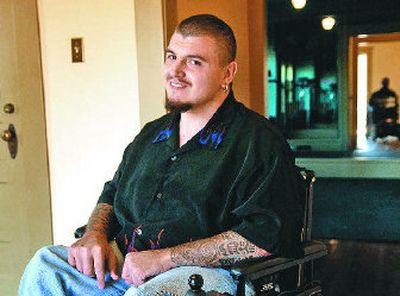
When Jason Peterson set out to find a new apartment, he knew it wouldn’t be easy. Peterson, who is 31 and uses a wheelchair, anticipated the difficulty in finding a unit that would meet his physical needs.
“I know from experience finding wheelchair-accessible housing is almost like finding a pot of gold at the end of the rainbow,” he says.
What Peterson didn’t anticipate was how much his decision to go from part-time to full-time work—with a corresponding but modest pay increase—would hinder his search.
“It seems as though handicap accessibility goes hand-in-hand with being low-income,” he says, adding that several realtors told him he would have an easier time finding accessible housing if he had continued to work part-time and earn less money. “To be told that if I was still low-income I could find more adequate housing for my needs is kind of a slap in the face.”
After a lengthy and fruitless search for an affordable “ADA” rental – one with amenities that comply with the Americans with Disabilities Act – Peterson figured it would be easier to buy a condo or loft and tailor it to meet his needs.
“Buying is something I’ve had in the back of my mind for a long time,” he says. “I knew I wanted a place of my own that I could make completely wheelchair accessible.”
Peterson, who earns enough to qualify for a $105,000 home loan, chose a custom ground-floor condo in the historic Kempis building at the base of the South Hill. And with a $12,500 bank grant and a potential $5,000 award from Spokane ARC to help cover the cost of making the unit wheelchair accessible, Peterson is only about $5,000 to $8,000 shy of paying for his new digs.
Although the unit is not yet built, Peterson is working with the building’s owner, RenCorp, to remodel an area that now houses a community laundry room and gym. An existing ramp along the building’s exterior will provide direct wheelchair access to the unit, which will include an accessible kitchen and bathroom, counters set at specific heights, special wall cabinets, an ADA-compliant oven and range, and a roll-in shower, among other amenities.
Peterson says one of the Kempis’ major selling points was its proximity to downtown.
“I’ve built my life around being 20 minutes from the downtown area by wheelchair,” he says, adding that he has lived near Spokane’s urban core for more than a decade. “And much of my activity happens after bus hours.”
Peterson has a degree in health information technology from Spokane Community College, and is now a self-described “computer geek” at Skils’kin, a community-based nonprofit that helps people with disabilities become more self-reliant. Peterson works in the company’s human resources department, where he handles software for the employee database.
At some point, however, he hopes to return to his studies and ultimately pursue a degree in architecture.
“I would like to build homes and office buildings that are accessible to people – to everyone, including people with disabilities,” he says. “One of the issues with construction for the disabled is that it looks like it is for the disabled.”
Peterson says he hopes to incorporate both form and function in his new condo.
“I want (anyone) to be able to walk in and not know a person with a physical disability lives there,” he says.
Fiercely independent, Peterson says he has worked to get to a point where he is not solely reliant on government funding. Although he continues to use Medicaid, Peterson says he no longer receives Social Security.
“Every dollar in my pocket or bank account I have worked for,” he says.
However, Peterson credits government entities that provide funding for ADA individuals with fostering his independence.
“Without those things I would never have had the ability to move out on my own, to discover who I was and what I was capable of,” he says. “All I’ve ever wanted since growing up is to be as independent and self-reliant as I can be.”