
Fabric of her life
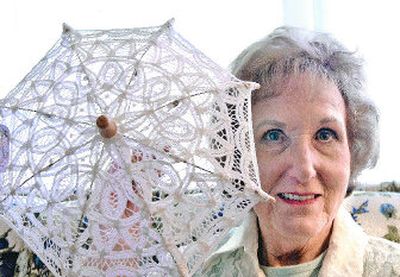
Wearing a lace shirt and a winning smile, Theresa Groves looked at ease among the shawls, handkerchiefs and tablecloths. All made of lace, of course.
A retired teacher, Groves is a member of the Alpha Delta Kappa International Honorary Organization for Women Educators. In 2005 she won the organization’s regional scholarship to study a subject of her choice, and thereafter give programs. She chose to study lace at the Victoria and Albert Museum in London. For two weeks she spent her days at the textile study room, poring over trays of finished lace from all over the world, classified by technique, countries of origin, and dates of production.
“People asked me, ‘Why don’t you go to Brussels, Belgium for lace? Why are you going to London?’ ” says Groves. “Well, it’s because when you go to Brussels, you see only partially finished lace – they’re working on it. But at the Victoria and Albert Museum in London, you see these huge pullout trays of completed lace from all over the world, through all of history.”
Although Groves has bought lace from antique stores and retail stores such as Sears, she also has received lace as gifts after friends and relatives learned of her scholarship.
And in just two years she has acquired quite the collection: lace from the Philippines made from pineapple stalks; limerick lace in the shape of a harp from Ireland made by nuns; red lace with a red dragon, from her ancestral country of Wales; nottingham lace from London, which is so well-made that it’s supposed to last 100 years.
When her friend Dorothy went to Switzerland to visit her sister-in law, Edith, Groves asked her to bring back some lace. But when Dorothy went to the stores, they were the same kind found here. She wailed to Edith, “Oh, dear, this is just like everybody else’s!” Edith said, “Just wait a minute,” and ran into her bedroom, then ripped a row of lace off her 100-year-old muslin sheets.
Groves also has some interesting anecdotes on the history of lace. The earliest European lace found is from the 12th and 13th centuries. But due to Egypt’s dry climate, lace has been found even earlier there, within tombs. From 1500-1700 babies wore lace swaddling clothes that were supposed to provide good posture and security.
“You would think that something so beautiful and dainty would have a beautiful past, but it doesn’t,” says Groves. “Because King George II said that only lace made in England could be brought into the country, the lacemakers started moving it across the Channel. They put it into the lining of suits and jackets. They’d take loaves of bread and scoop out the insides, fill them full of lace, put the top crusts on, then decorate them with frosting.”
During the French Revolution, lacemakers were beheaded as they had sold lace to the nobility. So it became a declining industry, until Queen Victoria revived it by wearing lace. Men stopped wearing lace shortly after the time of George Washington, in the early 1800s, although small boys continued to wear it. In the early 1900s, lace dresses were the fashion for the ladies. During World War II, lace snoods were worn for eveningwear. Lace hats and gloves were worn in the 1950s to parties or to church. And lace is still in fashion.
Groves also gives presentations on her collection of 30 antique sewing machines. Although just toy replicas, these minis can do chain stitch.
“They were made so girls could learn how to sew, because they were going to be sewing for 11 hours a day,” says Groves. “You’ve heard of the fireside touch. That’s what they actually did. In the evenings after working hard all day they would sew by hand. And then they got one of these; they were so wonderful.”
Another use for the toy machines was for demonstrators to show to farmers. In earlier days it was difficult to get to the store, so the fabric peddler came to the farms. But he couldn’t carry more than two or three big sewing machines.
“So he would bring some of these,” says Groves, gesturing towards a tiny replica. “And the farmer’s wife could show her husband and say, ‘Boy, you know, dear, if we had one of these, I could do the milking and still have your shirt repaired.’ “
“It was important enough, in our family history, getting a sewing machine, that it was written up in our genealogy,” Groves said.
In 1836, the United States Patent Office stated that every patent had to have a model, not more than one-foot square. Sewing machines were the new big thing. Elias Howell invented one, and then Singer. Soon several companies began manufacturing the cute little replicas.
Groves began her collection in 1973; it dates from 1910 to the 1990s. But the value is not just from their era.
“The cost of collecting antiques is not only the age, but how well preserved they are, and if they’re in working order,” says Groves
Groves gives presentations on lace and sewing machines to such groups as churches, sewing clubs, educational groups, the Salvation Army, and State Conventions.