
WSU defense makes big strides
PULLMAN – It was only the first third down on the first drive in the season’s first game, but it was to set a pattern Washington State’s defense is only just now eradicating.
On a third-and-7, Wisconsin quarterback Tyler Donovan dropped back, surveyed the field and waited for Travis Beckum to run his route. There was no pressure, no defender within 2 yards of Donovan. There was no pressure, no defender within 2 yards of Beckum. The result: completion, 15-yard gain, first down.
With a young secondary consisting of three new starters, head coach Bill Doba and his defensive staff started the season reticent to play aggressively, worried the youngsters in the secondary couldn’t handle the pressure.
Finally, after the Cougars dropped to 0-2 in the Pac-10 with a 48-20 loss at Arizona, the shackles came off. The pressure would be turned up, not only on the opposing quarterback but on the WSU secondary.
“One day, they just decided they don’t care anymore that we are young guys, they said if we want to win, you’ve got to start playing better,” freshman cornerback Chima Nwachukwu said. “You have to start covering 1-on-1 on the ‘islands,’ so that’s what we had to do.”
As is often the case whenever youngsters are given new responsibilities, the road to maturity hasn’t followed a straight line.
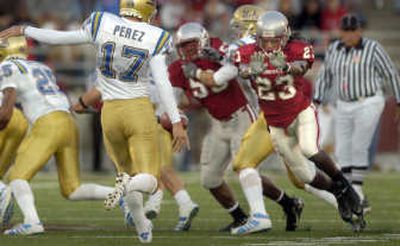
A turn toward respectability in the next game against Arizona State was followed by a blowout at Oregon. But the defense found the right path last week when UCLA came to town, holding the Bruins to 267 yards – 50 on one first-series play – and seven points.
Saturday, the group that’s ranked eighth in the Pac-10 in yards given up (it was 10th after the Arizona game) will try to slow down a Cal offense that is, when healthy, among the nation’s best.
But the Bears aren’t the focus here – WSU’s defense is, and how the Cougars (3-5 overall, 1-4 in the Pac-10) made such strides in such a short time.
There are three interrelated reasons:
“The maturation of the defensive backs.
When the season began in Wisconsin, the Cougars’ secondary featured one senior with game experience (safety Husain Abdullah) and three newcomers: true freshman Nwachukwu, sophomore corner Devin Giles, who hadn’t played in a game for two years, and junior college transfer Alfonso Jackson, the strong safety.
“Early on we had to play a bend-not-break defense,” assistant coach Leon Burtnett said, “because they were so young and we didn’t have a pass rusher, so we didn’t want to put too much pressure on them.”
But after the Arizona game, changes were made. Jackson was injured (his concussion hasn’t cleared completely, so he may not play this week), so sophomore Xavier Hicks moved in to his spot and has made 25 tackles in his two starts since. The other starters stayed the same, but they were told to carry the load.
“We gained a lot of experience playing in those games,” Nwachukwu said, “against a lot of big time receivers, Pac-10 receivers. Eight games into the season, we’re kind of seasoned.”
“We finally just went ahead with man coverage and came with full blitzes,” Doba said. “The less time that quarterback has, when he can’t throw on rhythm, we’ve got a chance to tackle the guy. It’s a combination of them getting better and us putting more pressure on the quarterback.”
“A change in scheme.
The front seven dominated the line of scrimmage against Arizona State and UCLA. Although the looks were different, the pressure came from a renewed emphasis on the blitz, with as many as four linebackers attacking the backfield.
Doba explained this week how WSU has nose tackle A’i Ahmu vary his rushing lanes, followed by linebackers attacking from different angles and spots.
“That makes the offensive line soft,” Doba said. “They have to get back and sort that out. Right now, with the talent that we have, that’s the best way for us to get push up the middle.”
With Kendrick Dunn injured against ASU, WSU relied on a 4-3 look but brought a linebacker or two or three on nearly every play.
When Dunn returned the next week, the Cougars switched to a 3-4 front, with the change paying off against the Bruins.
The linebackers are the guys getting the sacks, but it’s the play of Ahmu that stood out against UCLA. With the scheme change, Ahmu is playing almost every play, using his 6-foot, 290-pound body to clog the middle.
“I don’t really like being in there,” Ahmu said. “I’m getting triple- and double-teamed. But I’m going to do whatever it takes, and if that means taking up two guys every play, I’m going to take up two guys. … If I don’t hit my men, they are going to get onto the linebackers, and that’s going to mess up our whole scheme.”
The linebacker who has benefited the most from the changes would be Andy Mattingly, the sophomore from Mead High. A reserve when the season began, Mattingly filled in for an injured Dunn against ASU and had four sacks (the second-best mark for a WSU player) and five tackles for loss (tying the school record).
“A change in attitude.
All of the above may have gone for naught if the Cougars’ defenders hadn’t decided to turn it loose. Before the ASU game, Abdullah and linebacker Greg Trent, the two defensive captains, pulled the defense together for a heart-to-heart talk about playing with heart. It worked.
Even the Oregon debacle (the fourth-ranked Ducks put up 551 yards of total offense in the 53-7 rout) didn’t derail the defense. It may have actually helped.
”(The Oregon game) helped us point out where our mess-ups were,” Ahmu said, “and how vital it is to be in your assignment. One person out of 11 messing up is going to cause a touchdown.”
A bye week later, all 11 did their jobs and they dominated UCLA, especially in the third quarter.
With the game on the line – WSU led 10-7 entering the third quarter – the defense limited the Bruins to 24 yards and two first downs, both by penalty.