
Alarming situation
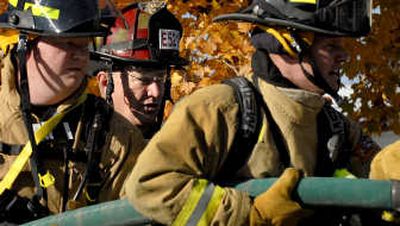
Volunteer firefighters are in short supply in North Idaho.
An informal survey of six local fire departments reveals that recruiting and retaining volunteer fire and emergency medical personnel has become increasingly difficult. And all of the officials questioned report a principal cause: People are too busy.
“These days, with the high cost of living, lots of people are working two jobs, and in many households, both the husband and wife have jobs,” notes Spirit Lake Fire Chief John DeBernardi.
The chief considers he’s lucky that his department is able to retain 20 volunteers to supplement his six paid firefighters.
Timberlake’s volunteer fire commissioner, Bat Masterson, is in a unique position to gauge the seriousness of the problem. In addition to leading Athol’s department, he sits on a statewide regulatory board for EMTs and paramedics.
“It’s a problem every department is faced with,” Masterson says. “For instance, at one time we had 20 to 30 volunteers; now, only 10 or 12 are active. They supplement our six paid firefighters.
“It takes a significant commitment of time. Our volunteers train every Monday and some Saturdays, and they’re held to the same standards as professional firefighters. And, over the years, the requirements have become much tougher.”
Dale Costa, the Kellogg fire chief, notes that the Silver Valley’s population is relatively small, and that Shoshone County’s three fire departments all are vying for volunteers.
His department boasts 30, and eight paid firefighters. That’s shrunk by at least six since November 1982 when the Bunker Hill Mine closed and people started leaving the valley.
Hauser’s Chief Larry Simms says at one time he had 22 volunteers, but now he’s down to 17. He’d like to have at least 20.
“It takes time and money to train a rookie,” he says. “The initial training for a firefighter is 160 hours, and then they have to put in another 40 to 60 hours for additional training like driving the equipment.
“And, if the person volunteers to be an EMT, that means 140 hours more.”
Equipment costs for the individual firefighter range from $1,500 to $2,000 he says, a not inconsequential sum for a small department.
Simms wants his volunteers to spend at least four hours a month on duty with his department.
The national average for a volunteer to stay with a department is three to five years, according to Simms, “but we’ve been lucky and we keep them for an average of 10 years.”
Since volunteers are required to take the same training as professional firefighters, some take the training, then move on to paid jobs in other jurisdictions.
“That’s happened, but it’s not too bad a problem,” says Simms.
Bob Maines, division chief for the Northern Lakes District in Hayden, says the 33 paid firefighters he supervises are supplemented by 15 to 20 volunteers, “and we couldn’t do our job without them.
“But the trend is downward for volunteers,” he says, “because of time constraints and the many demands on all of us these days.”
Chief Larry Naccarato runs his St. Maries Fire Protection District with 45 volunteers and just one paid employee: himself. The organization provides fire protection to 78 square miles of Benewah County and the south end of Kootenai County, including Harrison. But the volunteers also provide technical rescue services to residents of Kootenai, Benewah, Shoshone, Latah and Clearwater counties.
Like the other fire officials, Naccarato says the pressures of modern life including working spouses and child-care needs make it difficult to recruit and retain volunteers.
“It takes a minimum of 400 classroom hours just to get through the basics,” he says, “and there are frequent required updates that include academy sessions for fire fighters and officers plus training burns.
“It’s just plain tough on families.”
Todd Bryan has a volunteer’s perspective. He was a volunteer firefighter and EMT, plus served as volunteer coordinator for Kootenai County’s Fire and Rescue unit from 2004 to September of this year. He’s now a Bozeman resident and too busy with his new job to resume his volunteer avocation.
“About five years ago, Kootenai County had about 100 volunteers. They’re down to 40 now,” he reports.
That, despite the fact that recruitment efforts – including advertisements in movie theaters and banners on fire stations – produced bodies.
“Not only is there the pressure on families because both spouses are working, there’s the additional factor that our economy has changed. Back in the old days,” he says, “a lot of Kootenai County’s economy was based on mills. The owners would let their workers get away during the day to fight fires.
“Nowadays, it’s a rare employer who’ll let his folks go like that.”
Bryan says it takes eight months of schooling to train a firefighter or an EMT, “with classes in the evenings and every other Saturday, then task books to complete. Overall, it takes a year to fully qualify a volunteer for either job.
“I told every recruit, ‘If you’re in it for a T-shirt, buy one on the Internet.’ But despite my warnings, the attrition is terrific. We’d start with 80 students and graduate only about half,” Bryan says.
Why would anyone volunteer all that time away from family and put in all that effort just for the opportunity to go in harm’s way for no wages?
Here’s Bryan’s answer: “The training is awesome, to gain skills in hazmat, swift-water rescue, emergency medical service, for instance.
“Then there’s the brotherhood factor,” he says. “My closest friends are firefighters and EMTs. We’re part of a great organization. When you come right down to it, it’s a great feeling to be able to help your neighbor. And to tell the truth, no one is treated better in the community than a firefighter.”