
Taking flight

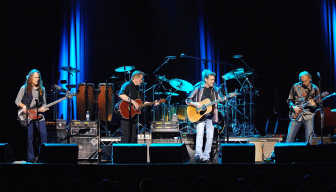
Of the 20 tracks on “Long Road Out of Eden,” the Eagles chose to kick off their new double album with the spine-tingling, choirboy harmonies of “No More Walks in the Wood.”
The tune telegraphs a simple mission statement: We’re on the same flight path.
That route took the Eagles to record heights in the ‘70s, when the country-rock behemoth racked up five No. 1 singles and four chart-topping albums before disbanding in 1980.
Though they’ve been breaking box-office records since reuniting in 1994, “Eden,” out today, is the group’s first studio album since 1979’s “The Long Run.”
“We worried for a while about how to fit in with what’s happening on radio,” says drummer Don Henley. “Finally we decided we just need to be who we are.”
Early on, the group dealt with “whether we were going to use modern stuff like hip-hop drum-machine beats,” says guitarist Glenn Frey, who shares chief songwriting duties with Henley.
“We ultimately concluded that what people like about the Eagles is our singing. So the criteria became: Can we sing this? Does it sound like the Eagles?”
Henley favored a single disc but yielded to Frey’s wish for a double album that would amply represent contributions from guitarist Joe Walsh and bassist Timothy B. Schmit.
“We didn’t say no to anything that was good,” Frey says. “We have four lead singers. That affords us a lot of options as far as keeping things diverse. You’re not hearing the same voice over and over.”
Boomer peer John Fogerty gushes his appreciation.
“I love the new Eagles record. It’s a sound I’ve missed,” he says.
“When they go into those harmonies, there’s a sense of keeping hope alive. You don’t hear that now, which is why young musicians are intrigued by radio stations that play classic rock.”
The first single, “How Long,” already is a country radio hit, and the group will perform Wednesday at the Country Music Association Awards – its first awards show appearance, despite three Grammy wins and 34 nominations.
Also enhancing sales prospects is an attractive price tag. The CD, sold only at Wal-Mart and Sam’s Club, is $11.88; the download is $10.88 at the retailers’ Web sites and eaglesband.com.
But matching previous peaks may prove impossible in today’s climate of sagging sales and unpredictable tastes.
The Eagles have sold 120 million albums worldwide, and their catalog rings up sales of 1.5 million copies annually.
With 29 million copies sold, “Eagles: Their Greatest Hits 1971-1975” is the top-selling album in U.S. history. “Hotel California” has sold 16 million copies, and no disc has failed to reach platinum status.
Why roll the dice now?
“We needed to do this album for our own personal fulfillment,” Henley says. “People tell us, ‘You’ve got enough money and fame. Why do this album?’ Being musicians is not a hobby. It’s a calling.
“There’s a life-affirming aspect to creating music. There’s more to it than getting songs on the radio and touring. It keeps us young and vital and off the shrink’s couch.”
Besides, he says: “I don’t think anybody wanted to go on tour again and play the same old songs.”
Henley, 60, and Frey, 58, the sole remaining founders, played together in Linda Ronstadt’s band before forming the Eagles and releasing a 1972 self-titled debut with the hits “Take It Easy,” “Witchy Woman” and “Peaceful Easy Feeling.”
Walsh came aboard after Bernie Leadon quit in 1975, and Schmit replaced Randy Meisner, who left in 1977. The band split in 1980 and re-formed for 1994’s No. 1 “Hell Freezes Over” album and lucrative reunion tour.
Frey and Henley hint that “Long Road Out of Eden” may signal the end of the road.
“If you listen to what we say in some of these songs, this could be the last one,” says Henley, who owes Warner Bros. two albums under his solo contract.
The band wants to take a break before hitting the road, Frey says: “We’re going to let the album seed and give people a chance to live with it before we commit to going around the world one more time.”
When it came to marketing “Eden,” the band decided to bypass the rule book.
Long distressed by the accounting practices, binding contracts, inefficiency and impersonal nature of major labels, the Eagles flew the coop, recording and packaging “Eden” on their own dime and then striking a pact with Wal-Mart.
For the first year, the CD will be offered exclusively at the giant chain, which bought a fixed quantity with the promise of no returns.
“I felt like they gave us the best chance to sell the most records,” Frey says bluntly.
Henley acknowledges that some condemn Wal-Mart’s labor policies and its effect on communities.
“We had doubts,” he says. “I’ve never been a fan of big-box retailers. My daddy was a small businessman.”
Yet he’s encouraged by the company’s environmental pledges and figured he’d never find a utopian alliance.
“There’s not a big corporation in this country that has clean hands, and certainly the major labels don’t,” Henley says.
“This is a one-album deal. We got flak for it, but everyone’s screaming for a new paradigm, so we found one.”
In another renegade move, the Eagles sealed a digital deal with Amazon after refusing iTunes’ terms.
“Amazon’s new MP3 store has better quality, and the songs are 10 cents cheaper,” Henley explains.
Henley is eager to start recording solo after the holidays, and Frey plans to make a big-band album in the spring.
The Eagles will convene early in 2008 for their annual band meeting to mull the future. Nobody’s in a rush. It’s not as if the Eagles are going out of style.
“There’s a lot of ageism in this business,” Henley says. “If you’re not young and cute and naked, you have a tough time. We’re still getting away with this because we never dressed flamboyantly or pranced around on stage.
“We always concentrated on the craft of songwriting, our bedrock. We’re not here to participate in the cult of personality.”